Showing posts with label Bishop of Norwich. Show all posts

Thursday, 28 March 2013

I should have blogged about... (#2)

Another thing I didn't blog about during my little hiatus was the latest batch of medal auctions from the 'Big Four'.  On Monday and Tuesday of this week we had DNW and on Wednesday Bonhams.

DNW sales are always jam-packed full of goodies and, with over  1,200 lots, take two days to clear.  It's always difficult to decide what to draw attention to when blogging on one of them.  There were some very nice lifesaving medals, which are an interest of mine.  Some were from the collection of John Wilson, an expert on the awards on the Society for the Preservation of Life from Fire (he literally wrote the book on the subject).  One group of medals that jumped out at me wasn't from John's collection, but was to a bathing superintendent, Frank Shooter, who was credited with saving over 300 lives during a remarkable career.  For some reason these were unsold - perhaps the estimate of £3,000-3,500 was just a little too rich when there was so much else on offer.

Launcelot Fleming's medals


The Right Reverend Launcelot Fleming (1906–1990), KCVO, DD
Bishop Launcelot Fleming
Another group that appealed to me on several levels (except for the price!) was that to Launcelot Fleming.  After studying geology and glaciology at Cambridge, he was ordained into the Church of England.  Unusually, he was then invited to join expeditions to Iceland in 1932, Svalbard (Spitsbergen) in 1933, and then the British Graham Land Expedition to Antarctica, 1934-37.  During the Second World War he was a naval chaplain, among other postings, serving on the battleship HMS Queen Elizabeth.  In 1949, despite having little parish experience, he was appointed Bishop of Portsmouth and, in 1959, Bishop of Norwich.  After retiring from that diocese in 1971, he became Dean of Windsor (he officiated at the funeral of the Duke of Windsor).  He died in 1990.  I'm pleased to say that his medals have returned to Norfolk, where they will be held by a private collector.

auction catalogue image
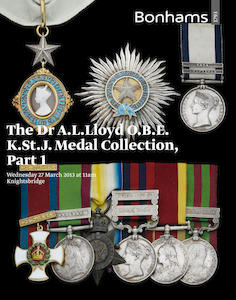
In contrast to DNW, Bonham's sale consisted of a single collection (in fact, just Part I of the collection) - the Dr A L Lloyd Collection of medals to medical personnel.

It was a lovely selection of material and just went to show how collecting themes can over-lap, for there was something for everyone.  There were medals from the Napoleonic Wars to modern conflicts; campaign awards; orders; gallantry awards; and long service medals.  Although there were medals to doctors and nurses who served in the Army and Air Forces, I'll pick out a couple of early pieces to naval surgeons.

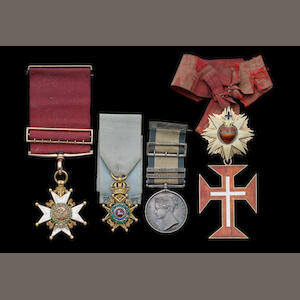
A C.B. and K.H. group of four to Inspector of Hospitals and Fleets G.Macgrath, Royal Navy, and one of Lord Nelson's famous Surgeons,
Sir George Magrath's medal group - £14,400
The item that caught press attention both before and after the sale was the lot to Horatio Nelson's personal surgeon, Sir George Magrath, which sold for £14,400.  The long catalogue entry quoted from several of Nelson's letters, in which he described Magrath as 'the most able medical man I have seen' and 'Mr Magrath, whom I admire for his great abilities every day that I live'.  He missed being with Nelson at Trafalgar as he was left in Gibraltar to assist with an outbreak of yellow fever.  In later years he was Inspector of Hospitals and Fleets for the Royal Navy.

Naval General Service 1793-1840,
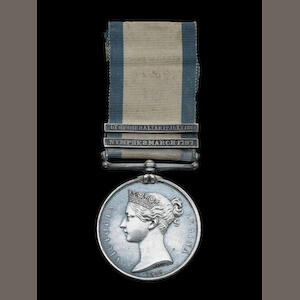
Naval General Service Medal to Surgeon B F Outram
 - an eye-watering £33,600.
Less eye-catching, but rather more desirable to at least two collectors was the single Naval General Service Medal to Surgeon B F Outram.  Although Outram (later Sir Benjamin Fonseca Outram KCB) had a distinguished career (he also was Inspector of Hospitals and Fleets), it is the numanistic aspects which are more important here than the 'man behind the medal'.  The medal has the clasps 'Nymphe, 8th March 1797' and 'Gut of Gibraltar 12th July 1801'.  The first clasp marks the engagement between HMS San Fiorenzo (Capt Sir Harry Neale), HMS Nymphe (Capt John Cooke) and the French ships Résistance (Cmdre Jean-Baptiste Montagniés Laroque) and Constance (Capt Desauney), who were returning from the farcical invasion of Pembrokeshire.  The second was awarded for an action off Cadiz when Sir James Saumarez defeated the French and Spanish fleets in July 1801. 

The significance of all this lies in the fact that the Naval General Service Medal wasn't awarded until 1847 and only to those surviving veterans who went through the application process.  As a result, some of the early, 'single ship' clasps were only claimed by a very few men.  Although 144 of the 'Gut of Gibratar' clasps were issued, there were only 5 of the 'Nymphe'.  This is a unique combination.  One knowledgeable collector of Naval General Service medals described this as a 'once in a lifetime' purchase.  Oddly enough, there was no indication of this scarcity factor in Bonham's catalogue description.  With an estimate of £5,000-7,000, the medal sold for an eye-watering £33,600 (inc premium).

Sunday, 4 November 2012

Edward Stanley, Bishop of Norwich

Edward Stanley D.D.
Bishop of Norwich
n. 1780 ob. 1849

Edward Stanley, was born in London on 1 January 1779, the second son and seventh child of Sir John Thomas Stanley, sixth baronet, of Alderley Park, Cheshire, and  his wife Margaret Owen (a Welsh heiress).  His elder brother, John Thomas, was first Baron Stanley of Alderley, and father of Edward John Stanley, second Baron Stanley and first Baron Eddisbury.

Edward's initial hopes were to enter the Royal Navy, but his family refused to allow that.  Accordingly, he was educated at St John's College, Cambridge and ordained in 1802.  In 1805 the family patronage was used to appoint him Rector of Alderley, a post he held until his appointment as Bishop of Norwich in 1837.  Here he took a great interest in the schools in his parish and the Church's social role: founding temperance societies, mechanics' institutes, and statistical societies.

He was an active naturalist, publishing A Familiar History of Birds, their Nature, Habits, and Instincts in 1836 and studied geology.  He was elected an Fellow of the Royal Society and President of the Linnean Society.

Norwich Cathedral

In 1837 he was nominated by Lord Melbourne to the Bishopric of Norwich, vacant by the death of the notoriously indolent Bishop Bathurst.  Here he proved himself an energetic bishop in the new Victorian mold - plurality was clamped down on and ecclesiastical discipline enforced.  He had 173 new parsonages built, doubled the number of schools and rendered them more efficient. The examinations for ordination were carefully conducted, and Stanley made himself personally acquainted with the previous career of every candidate.

He was a frequent attendee of the House of Lords, frequently speaking in support of Whig policies, such as Catholic relief, toleration of dissenters and, notably, the ragged school movement.  His political liberalism put him at odds with his diocese, but he was held in high personal regard.


In August 1849 he started for a tour in Scotland with his wife and daughters. At Brahan Castle in Rosshire he was taken ill, anddied from congestion of the brain on 6 September 1849.  His body was brought by sea from Invergordon to Yarmouth, and was buried in the nave of Norwich Cathedral, which also has a fine window in his memory.  The last time I saw it, his memorial was hidden by stackable chairs and the debris of modern worship.

Family

Stanley married Catherine (1792-1862), eldest daughter of the Revd Oswald Leycester in 1810.  They had had five children; Owen, Mary, Arthur, Charles and Catherine, each one of whom is of interest in their own right.

STANLEY OWEN H.m.s. Terror, Nipped By The Ice, In Fox's Channel.
HMS Terror in the ice, by Owen Stanley

Owen Stanley (1811-1850) was an officer in the Royal Navy and noted explorer.  He spent four years as a midshipman surveying South America, 1826-30, and was a Lieutenant on HMS Terror, during its 1836-37 expedition to the northern part of Hudson Bay. The ship barely survived the winter, at one point being forced 40 ft up the side of a cliff by the ice. In the spring of 1837 an encounter with an iceberg further damaged the ship, which was in a sinking condition by the time the captain was able to beach the ship on the coast of Ireland at Logh Swilly.

In 1846 Owen sailed for Australia as captain of HMS Rattlesnake, with the purpose of surveying the seas around the Great Barrier Reef and Torres Strait.  Junior naturalist on the ship was T.H. Huxley, soon to be known as 'Darwin's Bulldog'.  The bishop, as President of the Linnaean Society, was instrumental in having Huxley's early papers published. Owen would send cases of bird and shell specimens back home, where the family would assemble in the front hall of the palace to open the treasure chest, and would marvel at a little oppossum in a bottle. Owen died on his ship in 1850 and was buried in Sydney.

Mary Stanley (1813-1879) worked to support poor women.  She had a home in Norwich for factory girls and trained them in the production of lace.  In 1854, she went to the Crimea in charge of fifty nurses under Florence Nightingale.   In 1856 she converted to Catholicism, in the second wave of 'Puseyite perversions'.  She worked closely with Henry Edward Manning, continued with her philanthropic work, establishing savings clubs, an industrial laundry and creating employment for soldiers' wives in the production of army uniforms. During the Lancashire 'cotton famine' of 1861she helped Mrs Gaskell distribe aid to the unemployed weavers.

Arthur Penrhyn Stanley (1815-1881) became Dean of Westminster, and will almost certainly earn a 'Dead Bishops' blog entry of his own.

Charles joined the Royal Engineers, and was stationed at Hobart, Tasmania (then Van Diemen's Land). He died suddenly in 1849 from gastroenteritis - he, his father and his brother Owen all died within eight months of each other.

Catherine Maria married the Revd Charles John Vaugham, headmaster of Harrow School and Dean of Llandaff. She died in 1899.