Showing posts with label Medal collecting. Show all posts
Tuesday, 28 May 2013
Catching Up on My Subs
I've finally got around to renewing my subs to LSARS - the Life Saving Awards Research Society - a really interesting and friendly group of people. Unfortunately, the last time my subs came up for renewal I was otherwise engaged (in the Acute Care Unit) and allowed my membership to lapse...
Sadly, for my Mysterious Project to work I have to spend more money and show that I belong to Respectable Bodies. I'm therefore renewing my subs to the Society for Nautical Research (lapsed 2006) and the OMRS (lapsed way back in about 1987). It's amazing how these subs add up.
Friday, 24 May 2013
A Nice Day Out
![]() |
| Just a little of what I saw yesterday |
| Service in Egypt... |
The guy in question is a fellow medal collector, who I've corresponded with for a couple of years but never met, despite only living about 15 miles away. We'd spoken about it, we've dug diaries out and pencilled dates in, but we've never actually got around to it. This week we finally got there.
We made the obligatory "isn't the market getting expensive!" comments, though Bill (not his real name) are one different ends of the funding-spectrum of our hobby. Medal collectors will know what I'm talking about when I say that his solution is to move to the cheaper field of buying nurses medals...
Despite that, we had a really good chat about things, helped by the fact that we have many interests in common in addition to medals. It was one of the most pleasant days I've had for a long time.
Some eye-candy...
You know your in for a treat when your in the box-room of someone's house going through odd frames and you hear "and this is another GBE group..."
| An earl who served as a deck-hand in the naval reserve |
![]() |
| Comptroller to the Duke of Connaught |
![]() |
| Assistant Personal Secretary to George VI and Elizabeth II |
And even something for us naval types...
I got to handle the badge of a Companion of the Order of Indian Empire for the first time. I was surprised to find how light it was - they are hollow. Being made of 24ct gold and enamels, it's not surprising that they're so often damaged. Despite that, I'm confirmed in my belief that the higher grades of the Order of the British Empire are more attractive. We both agreed however, that nothing could touch the Order of the Star of India, designed by Prince Albert (who the tiara lovers among us know had a very good eye). Even Bill doesn't have a KSCI!
![]() |
| CBE Badge |
![]() |
| CIE Badge |
![]() |
| CSI Badge |
Thursday, 18 April 2013
Books and Stuff
What I've been reading this week....
I finished Men Whose Fathers Were Men: The story of a hobby by Centurion (Col Reginald Branwhite Jay). The hobby of the subtitle is medal collecting, and this 1925 book is a lovely period-piece. It takes the form of one decent chap telling another about collecting in a series of after-dinner chats in his den, during which he expounds on the C19th history of the British Army (particularly in the Peninsular and the First Afghan War). Very theatrical!
So I've now started Matthew Paris & Andrew Bryson, Parting Shots, which was one of the things I bought last week. It a selection of extracts from ambassadors' valedictory despatches from abroad.
I finished Men Whose Fathers Were Men: The story of a hobby by Centurion (Col Reginald Branwhite Jay). The hobby of the subtitle is medal collecting, and this 1925 book is a lovely period-piece. It takes the form of one decent chap telling another about collecting in a series of after-dinner chats in his den, during which he expounds on the C19th history of the British Army (particularly in the Peninsular and the First Afghan War). Very theatrical!
So I've now started Matthew Paris & Andrew Bryson, Parting Shots, which was one of the things I bought last week. It a selection of extracts from ambassadors' valedictory despatches from abroad.
What I've bought this week...
Sam Willis, The Admiral Benbow: The life and times of a naval hero - £3.99
Richard Sale & Eugene Potapov, The Scramble for the Arctic: Ownership, exploration and conflict in the far north - £2.99
Peter F Hamilton, Manhattan in Reverse - £3.99
Sam Willis, The Admiral Benbow: The life and times of a naval hero - £3.99
Richard Sale & Eugene Potapov, The Scramble for the Arctic: Ownership, exploration and conflict in the far north - £2.99
Peter F Hamilton, Manhattan in Reverse - £3.99
Thursday, 28 March 2013
I should have blogged about... (#2)
Another thing I didn't blog about during my little hiatus was the latest batch of medal auctions from the 'Big Four'. On Monday and Tuesday of this week we had DNW and on Wednesday Bonhams.
DNW sales are always jam-packed full of goodies and, with over 1,200 lots, take two days to clear. It's always difficult to decide what to draw attention to when blogging on one of them. There were some very nice lifesaving medals, which are an interest of mine. Some were from the collection of John Wilson, an expert on the awards on the Society for the Preservation of Life from Fire (he literally wrote the book on the subject). One group of medals that jumped out at me wasn't from John's collection, but was to a bathing superintendent, Frank Shooter, who was credited with saving over 300 lives during a remarkable career. For some reason these were unsold - perhaps the estimate of £3,000-3,500 was just a little too rich when there was so much else on offer.
Another group that appealed to me on several levels (except for the price!) was that to Launcelot Fleming. After studying geology and glaciology at Cambridge, he was ordained into the Church of England. Unusually, he was then invited to join expeditions to Iceland in 1932, Svalbard (Spitsbergen) in 1933, and then the British Graham Land Expedition to Antarctica, 1934-37. During the Second World War he was a naval chaplain, among other postings, serving on the battleship HMS Queen Elizabeth. In 1949, despite having little parish experience, he was appointed Bishop of Portsmouth and, in 1959, Bishop of Norwich. After retiring from that diocese in 1971, he became Dean of Windsor (he officiated at the funeral of the Duke of Windsor). He died in 1990. I'm pleased to say that his medals have returned to Norfolk, where they will be held by a private collector.
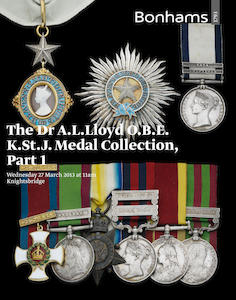
In contrast to DNW, Bonham's sale consisted of a single collection (in fact, just Part I of the collection) - the Dr A L Lloyd Collection of medals to medical personnel.
It was a lovely selection of material and just went to show how collecting themes can over-lap, for there was something for everyone. There were medals from the Napoleonic Wars to modern conflicts; campaign awards; orders; gallantry awards; and long service medals. Although there were medals to doctors and nurses who served in the Army and Air Forces, I'll pick out a couple of early pieces to naval surgeons.
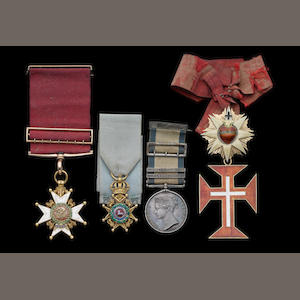
The item that caught press attention both before and after the sale was the lot to Horatio Nelson's personal surgeon, Sir George Magrath, which sold for £14,400. The long catalogue entry quoted from several of Nelson's letters, in which he described Magrath as 'the most able medical man I have seen' and 'Mr Magrath, whom I admire for his great abilities every day that I live'. He missed being with Nelson at Trafalgar as he was left in Gibraltar to assist with an outbreak of yellow fever. In later years he was Inspector of Hospitals and Fleets for the Royal Navy.
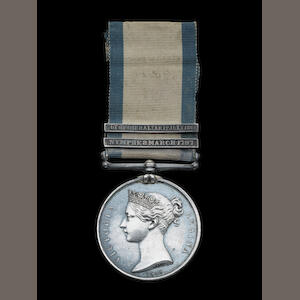
Less eye-catching, but rather more desirable to at least two collectors was the single Naval General Service Medal to Surgeon B F Outram. Although Outram (later Sir Benjamin Fonseca Outram KCB) had a distinguished career (he also was Inspector of Hospitals and Fleets), it is the numanistic aspects which are more important here than the 'man behind the medal'. The medal has the clasps 'Nymphe, 8th March 1797' and 'Gut of Gibraltar 12th July 1801'. The first clasp marks the engagement between HMS San Fiorenzo (Capt Sir Harry Neale), HMS Nymphe (Capt John Cooke) and the French ships Résistance (Cmdre Jean-Baptiste Montagniés Laroque) and Constance (Capt Desauney), who were returning from the farcical invasion of Pembrokeshire. The second was awarded for an action off Cadiz when Sir James Saumarez defeated the French and Spanish fleets in July
1801.
The significance of all this lies in the fact that the Naval General Service Medal wasn't awarded until 1847 and only to those surviving veterans who went through the application process. As a result, some of the early, 'single ship' clasps were only claimed by a very few men. Although 144 of the 'Gut of Gibratar' clasps were issued, there were only 5 of the 'Nymphe'. This is a unique combination. One knowledgeable collector of Naval General Service medals described this as a 'once in a lifetime' purchase. Oddly enough, there was no indication of this scarcity factor in Bonham's catalogue description. With an estimate of £5,000-7,000, the medal sold for an eye-watering £33,600 (inc premium).
DNW sales are always jam-packed full of goodies and, with over 1,200 lots, take two days to clear. It's always difficult to decide what to draw attention to when blogging on one of them. There were some very nice lifesaving medals, which are an interest of mine. Some were from the collection of John Wilson, an expert on the awards on the Society for the Preservation of Life from Fire (he literally wrote the book on the subject). One group of medals that jumped out at me wasn't from John's collection, but was to a bathing superintendent, Frank Shooter, who was credited with saving over 300 lives during a remarkable career. For some reason these were unsold - perhaps the estimate of £3,000-3,500 was just a little too rich when there was so much else on offer.
![]() |
| Launcelot Fleming's medals |
![]() |
| Bishop Launcelot Fleming |
In contrast to DNW, Bonham's sale consisted of a single collection (in fact, just Part I of the collection) - the Dr A L Lloyd Collection of medals to medical personnel.
It was a lovely selection of material and just went to show how collecting themes can over-lap, for there was something for everyone. There were medals from the Napoleonic Wars to modern conflicts; campaign awards; orders; gallantry awards; and long service medals. Although there were medals to doctors and nurses who served in the Army and Air Forces, I'll pick out a couple of early pieces to naval surgeons.
![]() |
| Sir George Magrath's medal group - £14,400 |
![]() |
| Naval General Service Medal to Surgeon B F Outram - an eye-watering £33,600. |
The significance of all this lies in the fact that the Naval General Service Medal wasn't awarded until 1847 and only to those surviving veterans who went through the application process. As a result, some of the early, 'single ship' clasps were only claimed by a very few men. Although 144 of the 'Gut of Gibratar' clasps were issued, there were only 5 of the 'Nymphe'. This is a unique combination. One knowledgeable collector of Naval General Service medals described this as a 'once in a lifetime' purchase. Oddly enough, there was no indication of this scarcity factor in Bonham's catalogue description. With an estimate of £5,000-7,000, the medal sold for an eye-watering £33,600 (inc premium).
Saturday, 23 March 2013
Books and Stuff
A regular(ish) round-up of my book news.
What I've bought this week...
Doreen J Waugh, The Faces of Orkney: Stones, Skalds and Saints - £1.99
Neil Gaiman, The Graveyard Book - 99p
What I've been reading this week...
Stephen Hunt, The Kingdom Beyond the Waves
Joseph Wambaugh, Hollywood Crows
'Centurion' (Reginald Branwhite Jay) Men Whose Fathers Were Men: The Story of a Hobby
What I've bought this week...
Doreen J Waugh, The Faces of Orkney: Stones, Skalds and Saints - £1.99
Neil Gaiman, The Graveyard Book - 99p
What I've been reading this week...
Stephen Hunt, The Kingdom Beyond the Waves
Joseph Wambaugh, Hollywood Crows
'Centurion' (Reginald Branwhite Jay) Men Whose Fathers Were Men: The Story of a Hobby
Tuesday, 11 December 2012
More Polar Medals from the RC Witte Collection
Back at the end of August when I reviewed the last medal auction from DNW, I focused on what they termed 'Exceptional Naval and Polar Awards from the Collection of RC Witte' and talked about the medals of Frank Wild, who had commanded the party Shackleton left on Elephant Island. In the sale this Thursday, there are 24 more items from this collection, and they are crackers, covering some of the most iconic naval engagements of the First World War and the interwar period.
But again my eyes are drawn to the polar medals.
Here there are three more of the men who were member of Shackleton's ill-fated Trans-Antarctic Expedition of 1914-16. Their ship, the Endurance, became trapped in the ice of the Weddell Sea and had to be abandoned in November 1915. Left with three lifeboats and
meagre rations, Shackleton and his men undertook a remarkable journey, camping out on floes that eventually took them 1600
miles north. Then, at last, in early April 1916, the ice began to break
up, allowing them to launch their lifeboats in a bid to reach
Elephant Island, 60 miles distant. Shackleton mounted what was to
become one of the great open-boat voyages of all time, namely his
remarkable journey in the James Caird to South Georgia, 800 miles
distant, from whence a successful rescue mission was mounted to collect
the 22 men who had been left on Elephant Island.
The first of these men is the expedition's surgeon, Alexander Hepburne Macklin. Remarkably, after their terrible experiences Shackleton's men all joined in the war effort on their return from the South Atlantic. Macklin joined the Royal Army Medical Corps and earned a Military Cross for treating wounded
under fire in Italy in 1918. He then volunteered for service in North Russia, where he was awarded the OBE and the
Russian Order of St. Stanislaus, 2nd Class, with swords, in addition to
being mentioned in despatches.
After the war, Macklin joined up with Shackleton again for a further expedition South, sailing in the Quest. He was attending Shackleton in the early morning of 5 January 1921 when the great explorer suffered a fatal heart attack and died.
Macklin settled in Dundee and practiced medicine, but his adventures weren't over - during the Second World War he saw service as a Lt-Col in the RAMC, seeing action in East Africa.
Mount Macklin in the Salvesen Range on South Georgia is named after him.
The second group is to Charles John Green who was serving as a baker aboard the P & O’s Andes when Shackleton’s Endurance called in at Buenos Aires in October 1914. Hearing that the expedition was looking for a cook, he signed up. Green was obviously a valued member of the crew - he agreed to go on Shackleton's next expedition while they were still abandoned on the ice in 1916! Accordingly he, too, was a member of the Quest expedition.
Lastly, there is the polar medal to one of the great Antarctic heroes, Chief Petty Officer Tom Crean.
Crean was a member of Scott's of both of Scott’s Antarctic expeditions and Shackleton’s 1914-16 expedition. This medal is for Scott's first expedition, where he made a great impression. On Scott's second voyage, Crean was in the running to be a member of the final polar party but (luckily for him) was not selected. Instead, it was Crean who found the abandoned tent that contained the bodies of Scot and his companions. In the meantime, Crean had saved the life of Edward R. G. R. Evans, the expedition's second-in-command. He was awarded the Albert Medal for his gallantry.
On Shackleton's Trans-Antarctic Expedition, Crean took command of one of ship’s boats in the epic boat-hauling journey that finally brought the team to open water - and their eventual arrival on Elephant Island. Shackleton selected Crean as one of the crew of the boat that he proposed to take to South Georgia, one of the greatest - if not the greatest - survival stories in the annals of Polar exploration. Shackleton later wrote:
These are just three of the lots from the 1714 on offer. There's loads else to see - not least a lovely collection of lifesaving awards.
Green's group (estimate £4,000-£5,000) hammered for £8,000
Crean's medal (estimate £25,000-£30,000) hammered for £23,000
To these prices should be added about 25% to cover fees and taxes.
But again my eyes are drawn to the polar medals.
![]() |
| Sir Ernest Shackleton |
![]() |
| Medals of A.H. Macklin, physician, polar explorer and soldier |
After the war, Macklin joined up with Shackleton again for a further expedition South, sailing in the Quest. He was attending Shackleton in the early morning of 5 January 1921 when the great explorer suffered a fatal heart attack and died.
Macklin settled in Dundee and practiced medicine, but his adventures weren't over - during the Second World War he saw service as a Lt-Col in the RAMC, seeing action in East Africa.
Mount Macklin in the Salvesen Range on South Georgia is named after him.
![]() |
| Medals of C.J Green, cook to the Endurance expedition |
![]() |
| Tom Crean |
Crean was a member of Scott's of both of Scott’s Antarctic expeditions and Shackleton’s 1914-16 expedition. This medal is for Scott's first expedition, where he made a great impression. On Scott's second voyage, Crean was in the running to be a member of the final polar party but (luckily for him) was not selected. Instead, it was Crean who found the abandoned tent that contained the bodies of Scot and his companions. In the meantime, Crean had saved the life of Edward R. G. R. Evans, the expedition's second-in-command. He was awarded the Albert Medal for his gallantry.
On Shackleton's Trans-Antarctic Expedition, Crean took command of one of ship’s boats in the epic boat-hauling journey that finally brought the team to open water - and their eventual arrival on Elephant Island. Shackleton selected Crean as one of the crew of the boat that he proposed to take to South Georgia, one of the greatest - if not the greatest - survival stories in the annals of Polar exploration. Shackleton later wrote:
![]() |
| Crean's polar medal |
One of the memories that comes to me from those days is of Crean singing at the tiller. He always sang while he was steering, and nobody ever discovered what the song was. It was devoid of tune and as monotonous as the chanting of a Buddhist monk at his prayers; yet somehow it was cheerful.On arrival at South Georgia in May 1916, the three weakest crew members were left with the James Caird, while Shackleton, Worsely and Crean undertook a momentous 36 hour trek, via mountain tops and glaciers, to reach the safety of the whaling station on the other side of the island - a journey never undertaken before. And after collecting their fellow crew members from the James Caird, as well as the boat itself, Shackleton, Worsley and Crean succeeded, after frustrating delays, in rescuing all 22 castaways on Elephant Island.
These are just three of the lots from the 1714 on offer. There's loads else to see - not least a lovely collection of lifesaving awards.
Edit - 14 Dec 2012
Macklin's group (estimate £18,000-£22,000) hammered for £31,000Green's group (estimate £4,000-£5,000) hammered for £8,000
Crean's medal (estimate £25,000-£30,000) hammered for £23,000
To these prices should be added about 25% to cover fees and taxes.
Wednesday, 21 November 2012
It never rains, but it pours...
The planets have trundled along in their tracks and come along to one of those conjunctions that cause medal collectors to pull their hair out - yes, the winter auctions are with us.
For some reason the big four auction houses have their quarterly sales around the same time, which always causes a glut of choice. This time it seems worse than usual. We have the following sales coming up.
As I say, we're spoilt for choice. Fortunately, I can't afford to buy anything so it isn't a problem for me.
For some reason the big four auction houses have their quarterly sales around the same time, which always causes a glut of choice. This time it seems worse than usual. We have the following sales coming up.
22 November SpinkEach play to their own strengths - Morton and Eden have a large section of World Medals and Orders, which are always eye-catching a attract the big spenders (particularly in the last twenty years, the Imperial Russian orders, which are favoured by oligarchs). DNW go for both quality and quantity - in a massive sale of 1715 lots they have a Boer War Victoria Cross, two George Crosses, George Medals and more other gallantry medals than you can shake a stick at. They are also dispersing a large collection of lifesaving medals, which look interesting.
29 November Morton and Eden (Sotheby's)
12/13 December DNW
13 December Bonhams
As I say, we're spoilt for choice. Fortunately, I can't afford to buy anything so it isn't a problem for me.
![]() |
| A Sea Gallantry Medal group of three awarded to Quartermaster Robert Matthews, S.S. Cymric, awarded three life saving medals for saving life on the St. Cuthbert, 1908 |
Thursday, 13 September 2012
DNW Sale: Day One
I'm having serious medal-withdrawal symptoms at the moment, and am feeling accordingly grumpy.
Today was day one of one of DNW's quarterly sales (the big one before the OMRS Conference) and I was prepared to settle down in front of the laptop for seven hours of LiveBid. I can't afford to buy anything, so I might as well watch, eh?
Unfortunately, The Wife (Who I Love Dearly) decided that it was necessary to do an on-line shop. This also takes seven hours, but involves a lot more swearing than heard at DNW. I suppose I accept her point that we need to eat - but if we didn't buy food, I might be able to afford medals...
Instead I walked the dog and made myself useful in the garden. I don't feel any sense of achievement though. Under the new austerity measures, I couldn't even go to the Red Roaster and get a caffine fix.
There were a couple of lots I was interested in (in an academic way, what with having No Visible Means of Support):
Tomorrow it's groups and gallantry, including the RC Witte collection, I've posted about previously. Expect some Big Money to be spent.
Today was day one of one of DNW's quarterly sales (the big one before the OMRS Conference) and I was prepared to settle down in front of the laptop for seven hours of LiveBid. I can't afford to buy anything, so I might as well watch, eh?
Unfortunately, The Wife (Who I Love Dearly) decided that it was necessary to do an on-line shop. This also takes seven hours, but involves a lot more swearing than heard at DNW. I suppose I accept her point that we need to eat - but if we didn't buy food, I might be able to afford medals...
Instead I walked the dog and made myself useful in the garden. I don't feel any sense of achievement though. Under the new austerity measures, I couldn't even go to the Red Roaster and get a caffine fix.
![]() |
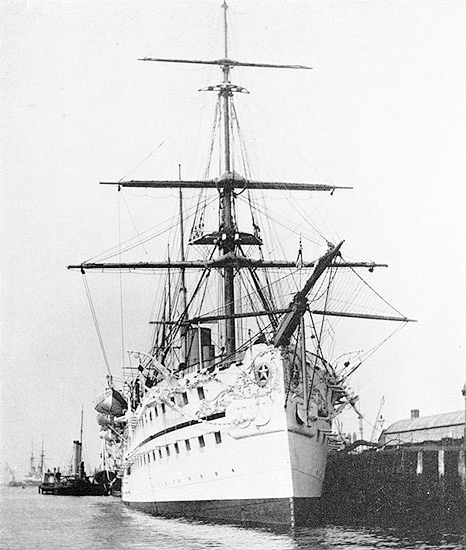
| HMS Malabar |
Egypt and Sudan 1882-89, dated reverse, no clasp (A. Robb, Cooper, HMS Malabar) edge bruising, contact marks, nearly very fineLot 115
£70-90Went for £160 hammer, which is what I would have paid (as I've said before auctioneer's estimates 'tend' towards the low side- £70-90 is what you might have expected to pay ten years ago). I hadn't done any research on him, but Cooper is a nice rate. He might have been any one of several Alexander Robbs in the navy at the time. HMS Malabar was a troopship - quite a nice looking one. I have a soft spot for mid to late nineteenth century shipping.
Lot 560 - BooksI haven't had the heart to have a proper look at how anything else sold today. Nobody's flagged anything particularly remarkable over on the British Medals Forum.
Trendell, A. J. R., The Colonial Year Book 1892; Mercer, Harding & Gent, The Dominions Office and Colonial Office List 1931; [H.M.S.O.], The Colonial Office List 1960; Hertslet, G. E. P. (Editor) The Foreign Office List (4) 1938; 1944; 1947; 1950; Walford, E., The County Families of The United Kingdom 1873; Kelly’s Handbook to the Titled, Landed and Official Classes (3) 1904; 1964; 1969; Debrett’s Peerage, Baronetage and Knightage (2) 1893; 1906, Who’s Who 1946; some volumes damaged, badly worn, poor and better condition (14)
£30-40
It seemed an interesting mix. Went for £75 hammer, which is the retail price of a decent second-hand copy of one of the Debrett's
Tomorrow it's groups and gallantry, including the RC Witte collection, I've posted about previously. Expect some Big Money to be spent.
Wednesday, 12 September 2012
Medal Collecting and Remembrance
From reading some of my recent posts one might be mistaken that medals are just the shiny things worn by young princes or won by glamorous fly-boys. This is far from the truth, as anyone who as spent time working through World War I casualty lists (as I have recently) will know. They can be a surviving memento of hard work and sacrifice otherwise forgotten.
This was brought back to me by a couple of posts on the British Medals Forum recently. The custodian of these medals has kindly allowed me to re-post their story.
The first is a little collection relating to 67540 Pte James Belcher, Royal Warwicks, late Warwickshire Yeomanry. It consists of a standard World War I pair - the British War Medal and Victory Medal - along with a memorial plaque and scroll indicating that he was a casualty. But most medal collectors are interested in more than the artifact - to us the real story is 'the man behind the medal'.
James Belcher was an employee of Mitchell & Butchers Ltd, Cape Hill Brewery, Smethwick. He enlisted as soon as he could do so at Leamington and served with the 14th Warwicks (1st Birmingham Pals) as part of the 5th Division. In September 1917 they were sent to Flanders where they were in action during the Third Battle of Ypres. The division then moved to Italy and took up positions in the line along the River Piave in late January 1918. They were recalled to France to assist with the German Advance in late March 1918 and were in action during the Battles of the Lys. On the 14th of August 1918 the 5th Division was withdrawn for two weeks rest. Then moved to The Somme where they were more or less in continuous action over the old battlegrounds until late October 1918.
James Belcher had been killed on 7 September: he was nineteen years old. He lies with 635 comrades in Ration Farm Military Cemeterty, La Chapelle-D'Armentiers, France (Grave Reference I. A. 7.).
He sleeps beside his comrades
In a hallowed grave unknown
But his memory is written in letters of love
In the hearts of those at home.
This was brought back to me by a couple of posts on the British Medals Forum recently. The custodian of these medals has kindly allowed me to re-post their story.
The first is a little collection relating to 67540 Pte James Belcher, Royal Warwicks, late Warwickshire Yeomanry. It consists of a standard World War I pair - the British War Medal and Victory Medal - along with a memorial plaque and scroll indicating that he was a casualty. But most medal collectors are interested in more than the artifact - to us the real story is 'the man behind the medal'.
James Belcher was an employee of Mitchell & Butchers Ltd, Cape Hill Brewery, Smethwick. He enlisted as soon as he could do so at Leamington and served with the 14th Warwicks (1st Birmingham Pals) as part of the 5th Division. In September 1917 they were sent to Flanders where they were in action during the Third Battle of Ypres. The division then moved to Italy and took up positions in the line along the River Piave in late January 1918. They were recalled to France to assist with the German Advance in late March 1918 and were in action during the Battles of the Lys. On the 14th of August 1918 the 5th Division was withdrawn for two weeks rest. Then moved to The Somme where they were more or less in continuous action over the old battlegrounds until late October 1918.
James Belcher had been killed on 7 September: he was nineteen years old. He lies with 635 comrades in Ration Farm Military Cemeterty, La Chapelle-D'Armentiers, France (Grave Reference I. A. 7.).
| Pte James Belcher - d. 7 Sep 1918, aged 19 |
| Not Forgotton - his mother's remembrance |
He sleeps beside his comrades
In a hallowed grave unknown
But his memory is written in letters of love
In the hearts of those at home.
Thursday, 6 September 2012
'Cats' Eyes' Cunningham Update
A little while ago, I blogged about Spink's Bentley Priory Battle of Britain Trust Appeal Charity Auction.
Among other things I said that the estimate of £140,000 for John ‘Cat’s Eyes’ Cunningham group 'is likely to be an under-estimate'. Well, the sale was today and the lot fetched £320,000 (after extras, that'll be a total of £396,800). That's an eye-watering sum of course, but it just confirms that the auctioneers' estimate was woeful. They must have know (as we did) that the real result would be much more. Why do they do this? Some claim that it's a 'teaser', pulling punters in - but why tell someone they can buy something for much less that you know you want them to pay? The real reason, I suspect, are the headlines in tomorrow's papers - 'medals sell for twice estimate'.
Anyway, as I said in the original blog, both the hammer price and the commission fees from this lot are going to charity. So, that's a result then.
![]() |
| Group Capt Cunningham's medal group |
Among other things I said that the estimate of £140,000 for John ‘Cat’s Eyes’ Cunningham group 'is likely to be an under-estimate'. Well, the sale was today and the lot fetched £320,000 (after extras, that'll be a total of £396,800). That's an eye-watering sum of course, but it just confirms that the auctioneers' estimate was woeful. They must have know (as we did) that the real result would be much more. Why do they do this? Some claim that it's a 'teaser', pulling punters in - but why tell someone they can buy something for much less that you know you want them to pay? The real reason, I suspect, are the headlines in tomorrow's papers - 'medals sell for twice estimate'.
Anyway, as I said in the original blog, both the hammer price and the commission fees from this lot are going to charity. So, that's a result then.
Friday, 31 August 2012
Books and Stuff
What's the point of posting, you ask, if for What I'm reading and On my to-read list I say 'The same as Last Week'?
Well, the point of having a regular post is to force me into reading and thus making a change. Gone for me are the glory days of commuting, where I had almost three hours of enforced reading time each day. I need incentive.
What I've bought this week...
I've had a bit of a charity shop blitz.
Audrey Niffenegger, The Time Traveller's Wife - 50p
HG Wells, The Shape of Things to Come - Although a 1973 paperback edition (the old Corgi Science Fiction Library), unread and very nice. 50p.
The First Aid Manual (9th Edn) - An as-new copy by Dorling Kindersley. It'll sit next to First Aid for Dogs and hopefully be used less. 75p.
A Brief History of the Royal Air Force - Apparently distributed to every serving member of the RAF and reserves in 2004. £1.00.
Leonard Mosley, Faces From The Fire: The biography of Sir Archibald McIndoe - £1.00
Well, the point of having a regular post is to force me into reading and thus making a change. Gone for me are the glory days of commuting, where I had almost three hours of enforced reading time each day. I need incentive.
What I've bought this week...
I've had a bit of a charity shop blitz.
Audrey Niffenegger, The Time Traveller's Wife - 50p
HG Wells, The Shape of Things to Come - Although a 1973 paperback edition (the old Corgi Science Fiction Library), unread and very nice. 50p.
The First Aid Manual (9th Edn) - An as-new copy by Dorling Kindersley. It'll sit next to First Aid for Dogs and hopefully be used less. 75p.
A Brief History of the Royal Air Force - Apparently distributed to every serving member of the RAF and reserves in 2004. £1.00.
Leonard Mosley, Faces From The Fire: The biography of Sir Archibald McIndoe - £1.00
A Naval and Polar Medal Miscellany
This is a completely different beast from the Bentley Priory sale, which is only 56 lots and predominantly RAF-related. By contrast, DNW covers all areas in a massive 1103 lots. It's accordingly more difficult to pick out choice items.
My eye is always drawn to naval and polar items, and lots 993-1014 are 'Exceptional Naval and Polar Awards from the Collection of RC Witte'. I don't know anything about RC Witte other than that he is Richard C Witte, the author of Fringes of the Fleet and the Distinguished Service Cross (1997) and Naval Double DSOs (1998). These were apparently written from collecting experience!
![]() |
| Frank Wild's CBE and Polar Medal |
As well as some eye-watering naval gallantry, this batch of Witte's collection also includes a couple more important polar groups:
A rare and poignant Boer War and Polar Medal pair awarded to Able Seaman G T Vince, Royal Navy, who died in Scott’s first Antarctic expedition in March 1902, after slipping down a steep ice slope during a blizzard while employed in a sledging party under Frank Wild.and
The unique Murmansk 1919 operations DSO, Shackleton 1914-16 Antarctic Expedition OBE, Q-Ship operations DSC group of twelve awarded to Commander J R Stenhouse, Royal Naval Reserve: according to Shackleton ‘he accomplished successfully one of the most difficult journeys on record, in an ocean area notoriously stormy and treacherous’ - just one chapter in a truly remarkable career spanning ‘square-riggers’ in the early 1900s to his death in action in September 1941
![]() |
| The Stenhouse group |
Saturday, 25 August 2012
Books and stuff
What I've been reading this week.
I've a few things open at the moment, but my main book has been Court of the Air by Stephen Hunt, part of his Jackelian Series. In principal Steampunk has always appealed to me, but I've been let down by the practice - many writers in the genre just aren't any good. This is an exception, and I've been enjoying it. Apparently there are six novels in the series so far - it remains to be seen whether the momentum can be maintained.
I don't like to have more than one novel on the go at the same time, as one often suffers. That's what's happened with A Watery Grave by Joan Druett. I've read about half of the book in a couple of sittings the other week, but put it down and haven't picked it up since.
Joan is an old friend of mine from the old days on the maritime history discussion group marhst-l. To tell the truth, I much prefer her non-fiction, but I've been meaning to give this book a go for quite a while. It's the first in the Wiki Coffin Mystery Series. Wiki is a Maori interpreter/guide on the United States Exploring Expedition, which set off in 1838 to chart and explore the Pacific. In the best tradition, Wiki has to solve the odd murder...
The copy I've got is the American paperback edition. As always, American paperbacks are much better quality than the ones we get here in the UK. It's a pleasure to hold and read. If paperbacks here were regularly this quality, Kindle and other e-books wouldn't be doing so well.
In non-fiction, I've been reading Howard Williamson's The Great War Medal Collectors' Companion. This is a ground-breaking compendium of work, weighty in all senses of the word, and will make a big difference to the collecting field. It's surprisingly well-produced - I expected something a little more 'self-published' in feel, but this is a substantial hardback, printed on glossy paper and with thousands (rather than hundreds) of illustrations.
I detect some sniffiness about this book over on the British Medals Forum. I'm not sure why.
Some people, who are quite happy to drop £500 on medals, will baulk at the price of books. This is short-sighted and goes against the advice we always spout to new-comers. As has been pointed out, if this £60 stops you buying a 1914 Star with a fake bar, it's paid for itself. If it helps you pick out an MM for the first day of the Somme among all the other MMs on a dealer's list, it's made you a couple of hundred quid. Apart from anything else, once the edition has sold-out copies will be selling well in advance of the cover price. Sadly, medal reference works are never cheap!
On my 'to-read' list
My wife is pressing me to read Sergei Lukyanenko's The Night Watch. But it's the first in a series of thick books and Russian...
One series I've been meaning to try out is The Dresden Files by Jim Butcher (the first book is Storm Front). They're about a private eye who happens to be a wizard and specialises in the paranormal cases the Chicago Police Department are stumped by. It might be fun, it might be spectacularly bad...
I've been meaning the read Vol 6 of William Laird Clowes The Royal Navy: A History from the Earliest Times to 1900. Earlier in the summer I read Vol 7 (yes, I know, it's the wrong order), which covered the period from the Second China War (1856-1860) to Queen Victoria's death (1901 and the Boer War). I found it a surprisingly good read. Vol 6 covers the War of 1812 to the Crimea War (1854).
What I've bought this week
Nothing. That's not surprising, but as it was my birthday is a bit disappointing.
I had girded my loins to buy WH Fevyer's The Distinguished Service Medal 1914-1920, but the one I'd sourced on Bookfinder for £10 turned out to be The DSM, 1939-1945. The actual copies of the book were more than I was prepared to pay. Note how quickly I've changed my tune about the short-sightedness of trying to buy cheap medal books!
I've a few things open at the moment, but my main book has been Court of the Air by Stephen Hunt, part of his Jackelian Series. In principal Steampunk has always appealed to me, but I've been let down by the practice - many writers in the genre just aren't any good. This is an exception, and I've been enjoying it. Apparently there are six novels in the series so far - it remains to be seen whether the momentum can be maintained.
I don't like to have more than one novel on the go at the same time, as one often suffers. That's what's happened with A Watery Grave by Joan Druett. I've read about half of the book in a couple of sittings the other week, but put it down and haven't picked it up since.
Joan is an old friend of mine from the old days on the maritime history discussion group marhst-l. To tell the truth, I much prefer her non-fiction, but I've been meaning to give this book a go for quite a while. It's the first in the Wiki Coffin Mystery Series. Wiki is a Maori interpreter/guide on the United States Exploring Expedition, which set off in 1838 to chart and explore the Pacific. In the best tradition, Wiki has to solve the odd murder...
The copy I've got is the American paperback edition. As always, American paperbacks are much better quality than the ones we get here in the UK. It's a pleasure to hold and read. If paperbacks here were regularly this quality, Kindle and other e-books wouldn't be doing so well.
In non-fiction, I've been reading Howard Williamson's The Great War Medal Collectors' Companion. This is a ground-breaking compendium of work, weighty in all senses of the word, and will make a big difference to the collecting field. It's surprisingly well-produced - I expected something a little more 'self-published' in feel, but this is a substantial hardback, printed on glossy paper and with thousands (rather than hundreds) of illustrations.
Me: [Describes the book before it arrived...]She knows me too well, and was spot on with the price of course. Luckily for me, Howard was kind enough to give me a free copy in return for some drudge work I doing on a project on the awards of the Military Medal.
Wife: That sounds expensive.
Me: Does it? How expensive would you say?
Wife: £60.
I detect some sniffiness about this book over on the British Medals Forum. I'm not sure why.
Some people, who are quite happy to drop £500 on medals, will baulk at the price of books. This is short-sighted and goes against the advice we always spout to new-comers. As has been pointed out, if this £60 stops you buying a 1914 Star with a fake bar, it's paid for itself. If it helps you pick out an MM for the first day of the Somme among all the other MMs on a dealer's list, it's made you a couple of hundred quid. Apart from anything else, once the edition has sold-out copies will be selling well in advance of the cover price. Sadly, medal reference works are never cheap!
On my 'to-read' list
My wife is pressing me to read Sergei Lukyanenko's The Night Watch. But it's the first in a series of thick books and Russian...
One series I've been meaning to try out is The Dresden Files by Jim Butcher (the first book is Storm Front). They're about a private eye who happens to be a wizard and specialises in the paranormal cases the Chicago Police Department are stumped by. It might be fun, it might be spectacularly bad...
I've been meaning the read Vol 6 of William Laird Clowes The Royal Navy: A History from the Earliest Times to 1900. Earlier in the summer I read Vol 7 (yes, I know, it's the wrong order), which covered the period from the Second China War (1856-1860) to Queen Victoria's death (1901 and the Boer War). I found it a surprisingly good read. Vol 6 covers the War of 1812 to the Crimea War (1854).
What I've bought this week
Nothing. That's not surprising, but as it was my birthday is a bit disappointing.
I had girded my loins to buy WH Fevyer's The Distinguished Service Medal 1914-1920, but the one I'd sourced on Bookfinder for £10 turned out to be The DSM, 1939-1945. The actual copies of the book were more than I was prepared to pay. Note how quickly I've changed my tune about the short-sightedness of trying to buy cheap medal books!
Friday, 24 August 2012
The Bentley Priory Battle of Britain Trust Appeal Charity Auction
The Spink publicity machine has kicked in for its The Bentley Priory Battle of Britain Trust Appeal Charity Auction on 6 September 2012.
The national press is focusing in on the sale of John ‘Cat’s Eyes’ Cunningham group, which include the CB, CBE, DSO, DFC and AFC. The estimate is £60,000-80,000, but like most medal auctioneer's estimates this is likely to be an understatement - I've never understood the point of such 'teasers'.
Meanwhile Spink have been tailoring their announcements to the local and regional press. For example, the Express and Star in the West Midlands have featured the George Medal awarded to RAF Sergeant Kenneth Lythgoe, a bomb disposal expert from Wolverhampton.
Unusually, the sale will benefit charity. Spink are donating their fees to the Bentley Priory Battle of Britain Trust appeal, which helps to preserve the site where Fighter Command had its HQ. The proceeds of the Cunningham lot will go towards flying scholarships for young people.
Edit - 7 Sep 2012
Oops..
I've used the wrong illustration for Cunningham's medal group.
In addition, the estimate was £140,000.
The national press is focusing in on the sale of John ‘Cat’s Eyes’ Cunningham group, which include the CB, CBE, DSO, DFC and AFC. The estimate is £60,000-80,000, but like most medal auctioneer's estimates this is likely to be an understatement - I've never understood the point of such 'teasers'.
![]() |
| Not 'Cat's Eyes' Cuningham's medal group - see edit |
Meanwhile Spink have been tailoring their announcements to the local and regional press. For example, the Express and Star in the West Midlands have featured the George Medal awarded to RAF Sergeant Kenneth Lythgoe, a bomb disposal expert from Wolverhampton.
![]() |
| Lythgoe's group |
Unusually, the sale will benefit charity. Spink are donating their fees to the Bentley Priory Battle of Britain Trust appeal, which helps to preserve the site where Fighter Command had its HQ. The proceeds of the Cunningham lot will go towards flying scholarships for young people.
Edit - 7 Sep 2012
Oops..
I've used the wrong illustration for Cunningham's medal group.
In addition, the estimate was £140,000.
![]() |
| Cunningham's real group |
Subscribe to:
Posts (Atom)