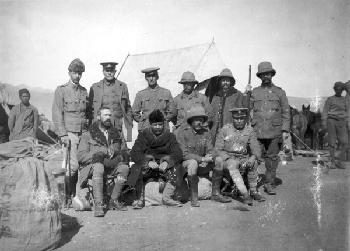
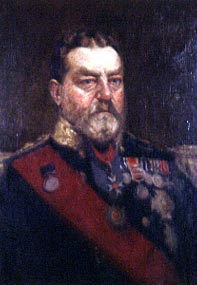
Showing posts with label 'Moustache'. Show all posts

Thursday, 26 September 2013

Vice-Admiral Lord Collingwood

Cuthbert Collingwood, 1st Baron Collingwood

Cuthbert Collingwood was born in Newcastle-upon-Tyne on 26 September 1750.  He was entered on the books of HMS Shannon (commanded by his cousin Capt Richard Braithwaite) and went to sea at the age of 11.  He stayed with Braithwaite for over ten years, serving with him in HMS Gibraltar and Liverpool.  In March 1772 he transferred to the Lennox, the guardship at Portsmouth.  He joined HMS Preston, flying the flag of Vice-Adm Samuel Graves, in February 1774 and sailed for North America.  He served as a member of the shore party during the Battle of Bunker Hill and was gazetted as Lieutenant for his actions.

In March 1776 he was appointed to the sloop HMS Hornet under Capt Haswell, serving in the West Indies.  This would not seem to have been a happy ship, and in September 1777 Lt Collingwood faced a court-martial on counts of disobedience of orders and neglect of duty.  He was acquitted, but the court noted the lack of 'cheerfulness on the part of Lt Collingwood in carrying out the duty of the sloop' and 'therefore recommended it to him to conduct himself for the future with that alacrity which is so essentially necessary for carrying on His Majesty's service'.  This would seem to be a black mark that would be difficult to overcome, yet Collingwood was soon appointed to HMS Lowestoffe.  Also serving as a lieutenant on Lowestoffe was Horatio Nelson: the careers of the the two men were to be entwined from now on.  Both men distinguished themselves fighting the French and Americans in the Caribbean.

Collingwood now replaced Nelson in a number of posts in quick succession - First Lieutenant of Lowestoffe; commander of HMS Badger in June 1779; and of the frigate Hinchingbrook in March 1780 (being made Post Captain in this command).  In Hinchingbrook, Collingwood played a leading part in the San Juan expedition - the abortive attempt to cross the Isthmus into the Pacific.  This was dogged by disease, with 180 of an original compliment of 200 of Hichingbrook falling ill (including Nelson, who almost died).  Collingbroke was in command of the expedition during the return to Jamaica.  He was now given command of HMS Pelican, but she was wrecked in a hurricane, the crew being stranded on the Morant Keys for ten days.  Despite the declaration of peace, the West Indies remained a busy station for the navy.  Collingwood, now in command of HMS Mediator, took the side of Nelson (senior captain on the station) in his dispute with the commander-in-chief over the interdiction of American trade.

From 1786 Collingwood spent several years 'on the beach'.  He consolidated his position in Northumberland society and in 1791 married Sarah Blacket, daughter of the Mayor of Newcastle.  They were to have two daughters.

The Glorious First of June 1794
With the outbreak of the French Revolutionary Wars, Collingwood was soon back in action.  In 1793 he was appointed to command HMS Prince, flgaship of Rear-Adm George Bowyer, later moving with Bowyer to HMS Barfleur.  In this ship he took part in the battle of the Glorious First of June (1794) off Ushant. Despite it's name, the outcome of this battle was inconclusive: the British did overwhelm the French fleet, but the convoy that the latter were protecting escaped.  Although Barfleur engaged the French ship Indomptable, which was dismasted, and Bowyer (who had lost a leg) received a knighthood, Collingwood felt that he had been overlooked by not being given the Naval Gold Medal awarded to other commanders.

The Battle of  Cape St Vincent, 1797
Following a spell in the Mediterrean with Nelson, Collingwood was in command of HMS Excellent for the Battle of Cape St Vincent (14 February 1797).   This engagement arose from Spain's declaration of war in 1796, which severely compromised the Royal Navy's position in the Mediterranean.  The Mediterranean Fleet, under Adm Sir John Jervis, intercepted a larger Spanish fleet which was attempting to  rendezvous with the French and then accompany a large convoy across the Atlantic.  Excellent had a distinguished part in this battle, receiving the surrender of the El Salvador del Mondo and the Santissima Trinidad, damaging other ships and assisting Cmdre Nelson in his famous capture of the San Josef and San Nicolas.   Jervis was given and earldom and Nelson appointed KCB.  When Collingwood was informed he was to receive a Naval Gold Medal he refused to accept it until he was also given one for the Glorious First of June.

In February 1799 Collingwood was advanced to the rank of Rear-Admiral (a matter of simple seniority) and appointed to the Channel Fleet, flying his flag in HMS Triumph, later in Barfleur.  In April 1804 he became Vice-Admiral.  In May 1805 he was detached from the fleet with a squadron to reinforce Nelson.  He blockaded Cadiz while Nelson pursued the French to the West Indies and back.  When Nelson intercepted the combined French and Spanish fleets at Trafalgar in October, Collingwood was his second-in-command and led the lee line, flying his flag in HMS Royal Sovereign.  Royal Sovereign was severely damaged during the battle (she had a long duel with the Santa Ana and was dismasted).  With the death of Nelson, command devolved to Collingwood: as the fleet was in a poor state and a storm was advancing, he ignored instructions given by Nelson to anchor.  No British ships were lost during the storm, but several of their prizes were either sunk or escaped to Cadiz.

HMS Royal Sovereign at Trafalgar
On 9 November 1805 Collingwood was promoted to Rear-Admiral and raised to the peerage as Baron Collingwood of Caldburne and Hethpool.  He was awarded an annual pension of £2,000 and received his third Naval Gold Medal (one of only three men to have been awarded three - the others being Nelson and Sir Edward Berry).

Collingwood now succeeded Nelson as Commander-in-Chief of the Mediterranean Fleet.  The next few years were occupied with low-level blockades and diplomatic duties, including an intervention in 1807 when the fleet was sent to the Dardanelles to fly the flag at a time it appeared the Ottomans might join France's war on Russia.  Collingwood's health was deteriorating and in 1810 he received permission to return to England, which he had not visited since 1803.  However, he died on 7 March 1810, shortly after leaving Port Mahon.  His body was brought to England and he was interred in the crypt of St Paul's Cathedral near Nelson's tomb.

Collingwood has not fared well at the hands of naval historians: Laughton's DNB article stated that "where he had Nelson's example or instruction he did splendidly; where Nelson's influence was wanting, he won no especial distinction: and after Nelson's death, as commander-in-chief, he did, at most, no better than scores of other respectable mediocrities who have held high command."  There has been some reassessment in recent years though.  His contemporaries thought highly of him, and he was apparently well-liked on the lower decks.  The Royal Navy named three ships and a training establishment after him.

The Collingwood Memorial at Tynemouth.  
The guns are from HMS Royal Sovereign.

Saturday, 13 July 2013

Rear-Adm R A J Montgomerie


Robert Archibald James Montgomerie was born at Rothesay, Isle of Bute, on 11 September 1855.

HMS Immortalité

In 1872 he was appointed Sub-Lieutenant in the screw-frigate HMS Immortalité , part of a detached squadron under Admiral Lambert.  The London Gazette of 19 June 1877, takes up the story:
At 3.10 on the morning of the 6th April, 1877, the Immortalité, being under all plain sail, moving 4½ knots with the wind, two points abaft the starboard beam, the port gangway look-out reported a man overboard, who proved to be Thomas Hocken. Mr Montgomerie, who was on the bridge, working a star meridian altitude at the chart table, on hearing the cry, ran over to the lee side, saw the man in the water, and jumped after him. He made for Hocken, asking if he could swim, to which Hocken answered "Yes, sir," but did not seem to be moving vigorously. Mr Montgomerie then got hold of him, hauled him on his back, and towed him to where he supposed the life-buoy would be, but seeing no relief, he told Hocken to keep himself a float while he took his clothes off. While he was in the act of doing so, Hocken, evidently sinking, caught hold of him by the legs, and dragged him down a considerable depth. Mr Mongomerie, however, succeeded in getting clear, and swam to the surface, bringing the drowning man with him. Hocken was now insensible, and too great a weight to support any longer, and finding that his only chance of saving himself was to leave Hocken, Mr Montgomerie reluctantly gave up the hope of saving him, and struck out for the ship. In the meantime the ship's course was stopped, and two boats were lowered, by one of which Mr Montgomerie was picked up. The latitudes in which the occurrence took place abound with sharks; and though there was a half-moon, the sea was sufficiently disturbed to render small objects, even boats, difficult to discern. Had not Mr. Montgomerie been a most powerful swimmer, he would have had little chance of life.

Albert Medal (Sea),
2nd Class
For this action, Montgomerie was awarded the Albert Medal (Sea), Second Class, the Silver Medal of the Royal Humane Society and, later, the RHS's Stanhope Medal for the most gallant rescue during the year.

In 1878 he was promoted to the rank of Lieutenant on the Royal Yacht Victoria and Albert; Commander in 1887 and Captain in 1894.  He was given command of the cruiser HMS Bonaventure in 1898, the battleship Prince George in October, 1900 and the cruiser Charybdis in 1901.
 
He was promoted Rear-Admiral in 1905, commanding Torpedo Boat and Submarine Craft Flotillas. In 1907 he became Rear-Admiral (D) in the Channel Fleet. He resigned in January 1908 following a dispute with the Admiralty over fuel allowances for training.  

In 1886 he married Aletha Marian Charrington, daughter of Spencer Charrington MP.  They had one son, Maj Victor Robert Montgomerie Charrington OBE of the Life Guards.  Admiral Montgomerie died on 1 September 1908.

Memorial to Admiral Montgomerie in Hundson Parish 
Church, Hundson, Herts
Made from the oak and gunmetal of HMS Caledonia, built in 
1802 and one of the Training Ships under his command 1904-5

Medals

Stanhope Medal
Order of the Bath - Commander (CB), 1892
Order of St Michael and St George - Commander (CMG), 1904
Royal Victorian Order - Commander (CVO), 1907
Albert Medal (Sea), 2nd Class, 1877
Egypt Medal (1882-89)
Khedive's Star (1882)

Royal Humane Society Silver Medal, 1877
Royal Humane Society Stanhope Medal, 1877

Monday, 17 December 2012

Admiral Sir Christopher Cradock

Sir Christopher Cradock, KCVO, CB, SGM

Christopher George Francis Maurice Cradock was born on 2 July 1862 at Hartford, Yorkshire, the fourth son of Christopher Cradock and his wife Georgina.

Cdr Cradock and dogs
He entered the Royal Navy in 1875 and saw his first action as a midshipman three years later during the occupation of Cyprus.  In 1884 he landed as part of the naval brigade, and served as part of the Eastern Sudan field force, being selected by the governor-general of the Red Sea to act as his aide-de-camp.  He was awarded the Order of the Medjidie.  After service on the Royal Yacht, he was promoted to Commander and served in the Third China War, commanding the combined British, German and Japanese naval brigade that stormed the Taku Forts in July 1900 (awarded the Prussian Order of the Crown) and the allied forces in the Relief of Tientsin.  He was noted for early promotion.


Cradock wrote two minor books; Sporting Notes in the Far East (1889) and Wrinkles in Seamanship (1894), but it was his Whispers from the Fleet (1907) that outlines his naval philosophy.  Addressed to officers entering upon their careers, he throws scorn on the civilians driving the naval arms race, who were 'for ever writing to the newspapers to prove... that unless we do something we shall in ten years time be seven-eighths of a battleship behind the combined navies of the world'.  As the DNB put it, 'to him the navy was not a collection of ships, but a community of men with high purpose'.


Wreck of the SS Delhi
Cradock was promoted Rear-Admiral in 1910.  In December the passenger ship SS Delhi grounded off Cape Spartel in Morocco.   Cradock in HMS London went to the assistance of the passengers, which included the King's sister, the Princess Royal, her husband the Duke of Fife and their children.  In bad weather, it took five days to ferry the 100 passengers to safety, and several seamen lost their lives.  Craddock was awarded the Sea Gallantry Medal.

In 1913 he took command of the North American and West Indies Station.  At the outbreak of war in August 1914, he had responsibility for an area from Canada to Brazil and the immediate duty of finding and destroying the German commerce-raiding cruisers, which were operating independently in the North and South Atlantics.  After satisfying himself that the North Atlantic trade routes were safe, Cradock joined the South Atlantic Squadron and raised his flag in HMS Good Hope, with the aim of sinking the cruiser Dresden.

http://www.gwpda.org/naval/images/cfgoodhope.jpg
HMS Good Hope

While cruising off the east coast of South America, Cradock received information from the Admiralty that Admiral von Spee's German East Asia Squadron was moving eastwards across the Pacific, with the Falkland Islands coaling station as its presumed destination, and that Cradock should 'be prepared to meet them in company'.

Cradock's force consisted of obsolete and under-armed vessels, crewed by naval reservists called up a few months earlier.  These were the armoured cruisers HMS Good Hope and HMS Monmouth, the modern light cruiser HMS Glasgow, three other light cruisers, a converted liner—HMS Otranto—and two other armed merchantmen. The armoured cruiser HMS Defence, had been due to join the squadron, but this ship was diverted, and the pre-dreadnought battleship HMS Canopus took its place. Canopus had been due to be scrapped, but was reprieved on the outbreak of war: although designed to make 18.5 knots, she could barely manage 12 - half the speed of the rest of the squadron.  The Admiralty refused Craddock's request for further reinforcements.

After formally protesting his orders, Craddock split his forces in two; half to patrol the east coast of South America and the other the west coast.  Good Hope, Glasgow, Monmouth, Otranto and Canopus made up the west coast squadron and rounded the Horn, with Canopus detached and following the other ships as best she might.

Meanwhile, on 30 October a new board of Admiralty had been appointed with Lord Fisher as First Sea Lord.  They at once telegraphed to him that he was to keep his squadron concentrated and for reinforcement from Defence - and that he was not expected to fight without the Canopus. The new orders never reached him.

On October 29 Glasgow was sent to the port of Coronel in Chile, while there picked up radio transmissions between Leipzig and one of her colliers (the signals were warning von Spee of Glasgow's presence). The squadron was reformed and spread out to sweep north.  On 1 November 1914 Good Hope, Monmouth, Glasgow and Otranto encountered von Spee's force: Scharnhorst, Gneisenau, Leipzig and Dresden, with Nürnberg thirty miles to the north.  These modern vessels were much superior to Cradock's force.  Canopus was still 300 miles away to the south, escorting the squadron's colliers.

http://static1.akpool.de/images/cards/59/597325.jpg
Admiral Maximilian von Spee
Craddock drew the German force south.  With evening drawing on he had the option of withdrawing, falling back on Canopus' position;  had he done so, he would probably have escaped in the failing light, though he would have had to leave the slower Otranto to her fate.  However, his orders were to intercept and engage the enemy, and it was uncertain whether he would be able to find von Spee again.  Craddock was also aware that Rear-Admiral Troubridge, had been court-martialled that August for failing to engage the enemy despite the odds being against him.  Cradock turned towards the German line.

At about 1930 at 12,000 yards the German armoured cruisers opened fire, keeping their distance so as to stay out of the range of the British guns.  The setting sun silhouetted the British squadron whilst the German ships were hard to see in the failing light.  The third salvo from Scharnhorst hit Good Hope, knocking out her forward 9.2 inch gun. Monmouth was also hit by the third salvo from Gneisenau, setting her forward turret on fire. The visibility deteriorated so that the Germans had to target the fires on the British ships whilst the British had to make do with aiming at the enemy gun flashes. Leipzig and Glasgow engaged each other whilst Dresden fired on Otranto which rapidly pulled out of the line and fled, enabling Dresden to also engage Glasgow.  At 1950 Good Hope suffered a magazine explosion, the crippled ship then drifting out of site and sinking soon afterwards. There were no survivors.

'Rear Admiral Cradock's flagship, HMS Good Hope on fire', by W.L. Wyllie

Monmouth was also on fire and listing to port. Glasgow had been hit five times and seeing that Monmouth was beyond help fled to avoid certain destruction and to warn Canopus to turn back. Nürnberg , ariving on the scene finished Monmouth off with gunfire at point blank. Again there were no survivors.

Within two hours the British had lost two battle cruisers and almost 1,600 men, including Admiral Cradock. The only damage to the Germans was two hits on Scharnhorst and four hits and three wounded on Gneisenau.

In response to the first major defeat suffered by the Royal Navy in over 100 years, and in answer to the continuing threat from von Spee's ships, a substantial new squadron was put together under the command of Vice-Admiral Doveton Sturdee (ironically as a demotion from a staff position following the changes at the Admiralty).  On 8 December 1914 von Spee, low on coal and having used half his ammunition at the Battle of Coronel, arrived at the Falkland Islands only to find Sturdee waiting for him.  In the ensuing battle, Scharnhorst, Gneisenau, Nürnberg and Leipzig were all sunk and von Spee and almost 2,200 German sailors killed.

Arthur Balfour (foreign secretary) unveils the memorial to Admiral Cradock at York 
(Click on link for movie)
Orders and Medals

Monday, 10 December 2012

Sir Francis Younghusband


Sir Francis Younghusband, KCSI, KCIE
Sir Francis Younghusband was an odd mix - soldier, colonial administrator, explorer and mystic.

Francis Edward Younghusband was born at Murree, in the North West Frontier (now Pakistan), on 31 May 1863, the second son of Major (later Major-General) John William Younghusband and his wife, Clara Jane.  His uncle was Robert Shaw, the first Englishman to cross the Himalyas to Yarkland and Kashgar - Francis was to undertake similar work in 'the Great Game', whereby Russia and British India strove for influence in Central Asia.

Afghanistan caught between Russia and Britain in 'the Great Game'
He was educated a Clifton College, near Bristol, and the Royal Military College, Sandhurst, being commissioned into the 1st (King's) Dragoon Guards in 1882.  In 1886 he joined Sir Henry Evan Murchison James on an expedition into Manchuria and China, visiting areas unseen by Europeans for almost two centuries.  Younghusband returned from Peking to India via the Gobi Desert, the first European to cross it. 

In 1889 he made further ventures into Central Asia north of British India, encountering Capt Grombehevski, who was doing similar work for the Russians.  Younghusband, now a captain, was attached to the Indian foreign department, and spent 1890-91 on a round trip to Kashgar - his encounters with Cossack patrols led to an international incident, and the British government forcing the Russians to back down in their plans to annex large swathes of territory next to Afghanistan.

Younghusband, c.1901
Younghusband published an account of his journeys in 1896 as The Heart of a Continent: A Narrative Of Travels In Manchuria, Across The Gobi Desert, Through The Himalayas The Pamirs And Hanza, which brought him to public attention.  He also accompanied to Chitral Relief Force as a correspondent for the Times (and probably acted in some other, more shadowy, capacity).  He was awarded the Founder's Medal of the Royal Geographical Society and appointed a CIE.

Younghusband was appointed a political officer in Husan and made a friendship with George Curzon (later the 1st Marquis Curzon, Viceroy of India).

He again acted a as corespondent for the Times in 1897-98, this time in South Africa, where he reported on the Jameson Raid, and the disputes which were to lead to the Second Boer War.

In 1902 Curzon appointed Younghusband head of a mission to Tibet, who was feared to be negotiating a settlement with the Russians.  Younghusband, with a military force commanded by J.R.L. Macdonald, exceeded his orders and lead an invasion of the country.  Despite Younghusband's assurances that at 'we are not at war with Tibet and that, unless we are ourselves attacked, we shall not attack the Tibetans' conflict soon arose.  The Tibetans were hopelessly outmatched and a series of what can only be described as massacres followed.
File:Younghusband-team-1904.jpg
Younghusband and staff in Tibet

Younghusband entered Lhasa in August 1904 and dictated terms to the Tibetan government, which paid an indemnity, recognized the Sikkim-Tibet border, and declared that Tibet would have no relations with any other foreign powers.

The invasion proved controversial in London, but Younghusband was eventually confirmed in his actions and advanced in KCIE.

From 1906 until his retirement in 1909, Younghusband was resident officer in  Kashmir.  He returned to England in 1910, and published India and Tibet.  He became prominent in the Royal Geographical Society, and served as it's president from 1919 to his death.  He was chairman of the Mount Everest Committee, which organised attempts to climb the mountain.  He was appointed KCSI in 1917.

Younghusband had become interested in spiritualism and Eastern Religions.  He published The Life in the Stars in 1927 and The Living Universe in 1933.  He helped in the organisation of the Conference of Religions of the Empire held in London in 1924 and founded the World Congress of Faiths in 1936.  His beliefs became increasingly bizarre, following a vision on the return from Tibet, Younghusband devised a new religion, arguing that there was a Supreme Being on an alien planet influencing events on Earth through telepathy and advocating Free Love.

Younghusband died at Lychett Minster, Dorset, the home of his mistress and follower, Lady Lees, on 31 July 1942.

Orders, Decorations and Medals


Order of the Star of India
Knight Commander (KCSI), 1917


Order of the Indian Empire
Companion (CIE), 1896
Knight Commander (KCIE), 1905


Kaisar-i-Hind Medal (in Gold), 1901


Tibet Medal BAR.svg Tibet Medal

Monday, 29 October 2012

Admiral of the Fleet Sir Arthur Wilson


Adm of the Fleet Sir Arthur K Wilson, VC, GCB, OM, GCVO

Arthur Knyvet Wilson was born in Swaffham, Norfolk, on 4 March 1842.  He was the son of Rear-Adm George Knyvet Wilson and nephew of Maj-Gen Sir Archdale Wilson, who commanded the garrison during the Siege of Delhi (Arthur was to inherit the baronetcy awarded to Sir Archdale for this).He was educated at Eton and entered the Royal Navy in 1855.

Early Career

As a Midshipman, he served on HMS Algiers during the Crimean War. The ship served in the Black Sea, near Sebastapol and was involved in the bombardment of the Kinburn forts. Wilson transferred to HMS Colossus when the Algiers went for a refit in Malta. While serving on this ship, he was sent ashore to search for an Army Captain’s dog that had got lost near Balaclava. By the time he returned, the ship had sailed for Britain and he was forced to use another ship to return home. He was then posted to HMS Raleigh which was to serve on the China station. In March 1857, the ship ran aground on a submerged rock and was lost. The officers and men were landed and Wilson was then transferred to HMS Calcutta, the flagship. He was serving on this ship during the Second China War.

In 1867, he was one of the party of British naval officers sent to Japan to set up a school for naval officers at Yedo and take up the post of Instructor.   In 1870, while at HMS Excellent, he was a member of the committee appointed to inquire into the capacity of the Whitehead Torpedo.  In 1876, he became Commander at HMS Vernon, the newly established Torpedo School at Portsmouth in recognition of his previous experience in torpedo research. While he was there, he was promoted to Captain in April 1880 and asked to re-write the navy’s torpedo manuals. He also invented aiming apparatus for the torpedo and worked out a method of submarine mining and countermining adapted to naval requirements. In 1882, Wilson was appointed to command HMS Hecla, a torpedo depot ship.

Egypt and the Victoria Cross

Hecla was used as a transport ship during the Anglo-Egyptian War. The ship contributed a small detachment as a Naval Brigade for the second battle of El Teb on 29th February 1884. Although Wilson was not actually part of the brigade, he joined the battle as an observer. 

What happened next is recounted in the London Gazette for 21 May 1884.
Sailors using a ship-based Gardner Gun
This Officer, on the staff of Rear-Admiral Sir William Hewett, at the battle of El-Teb, on the 29th February, attached himself during the advance to the right half battery, Naval Brigade, in the place of Lieutenant Royds, RN mortally wounded.  As the troops closed on the enemy's Krupp battery the Arabs charged out on the corner of the square and on the detachment who were dragging the Gardner gun.

Captain Wilson then sprang to the front and engaged in single combat with some of the enemy, thus protecting his detachment till some men of the York and Lancaster Regiment came to his assistance with their bayonets. 

But for the action of this Officer Sir Redvers Buller thinks that one or more of his detachment must have
been speared.

Captain Wilson was wounded but remained with the half battery during the day.


Richard Noyce, Curator of Artefacts at the National Maritime Museum, gives a more vivid account in this video:


Wilson was presented with the Victoria Cross at a special ceremony on Southsea Common on 6 June 1882. He recorded in his diary 'Docked ship.  Awarded Victoria Cross.'

Later Career 

In 1889, he was again appointed to command HMS Vernon. In 1893, he was appointed to HMS Sans Pareil and witnessed the collision of HMSs Camperdown and Victoria, which led to the sinking of the Camperdown with severe loss of life, including Admiral Sir George Tryon.

Wilson was promoted Rear Admiral in 1895. He was appointed as Controller of the Navy and Third Sea Lord. Four years later, in 1901, he was promoted again to Vice Admiral and made Commander in Chief of the Channel Squadron. During his period in this position, he improved and brought in modern methods of tactics in view of the technical advances in battleships.

In 1907, he was made Admiral of the Fleet by a special Order in Council, after successfully commanding the Channel and Home fleets. In 1910, he was appointed First Sea Lord. He did not favour the use of submarines as a means of firing torpedoes, famously calling them 'a damned un-English weapon'. After two years, he was dismiissed ('like a butler') after differences of opinion in regard to administration and policy with the First Lord of the Admiralty (his Parliamentary counterpart), Winston Churchill. On his 70th birthday he was placed on the Retired List and was made a member of the Order of Merit.

However, on the outbreak of war in 1914 he returned to assist Lord Fisher, the new First Sea Lord, at Churchill's request.  Fisher and Wilson clashed continuously until the former's resignation in 1915.  Due to strong opposition from sea-going admirals and others, Wilson was not re-appointed First Sea Lord
let it not be A. K. Wilson who is a man of quite inferior calibre and who backed up Winston in his folly over the naval attack on the Dardanelles. AKW is all right knocking down Fuzzy Wuzzies with his fists, or getting a cable round a bollard, but the idea that he is a strategist of the first water has no foundation in fact and he is dumb at War Councils and institutions of that character
He retired for a third time in 1918. When his brother died in 1919, he became the 3rd Baronet. Wilson died on 25 May 1921 at his home in Swaffham.


The Medals 

Sir Arthur's medals are held by the Royal Navy Museum, Portsmouth.


Victoria Cross
Knight Grand Cross, Order of the Bath (GCB)
Order of Merit (OM)
Knight Grand Cross, Royal Victorian Order ( GCVO )
Crimea Medal (1854-56), 1 clasp: 'Sebastopol'
Second China War Medal (1857-60) 2 clasps: 'Canton 1857' - 'Taku Forts 1858'
Egypt Medal (1882-89) 3 clasps: 'Alexandra 11th July' - 'El-Teb' - 'Suakin 1884'
Queen Victoria Diamond Jubilee Medal (1897)
King Edward VII Coronation Medal (1902)
King George V Coronation Medal (1911)
Grand Officer, Legion of Honour (France)
Order of the Medjidieh (3rd Class) (Turkey)
Order of Naval Merit: Grand Cross (Spain)
Khedive's Star (1882)
Turkish Crimea Medal (1855-56)
Knight Grand Cross, Order of Dannebrog (Denmark)
Knight Grand Cross, Order of the Netherlands Lion (The Netherlands)

Monday, 22 October 2012

Admiral Sir Harry Rawson

Sir Harry Holdsworth Rawson, GCB, GCMG


Harry Holdsworth Rawson, the second son of Christopher Rawson of Woolwich, was born at Walton-on-the-Hill, Lancashire on 5 November 1843, and educated at Marlborough College.

He entered the Navy at the age of thirteen years and five months, and was appointed to HMS Calcutta, the flagship of Sir Michael Seymour on the China Station. As a Midshipman he served in the Second China War, being present in Calcutta’s launch at the capture of the Taku Forts in 1858. In 1860 he landed as ADC to Captain Dew of the Encounter, and was present at the second capture of the Taku Forts, the Battle of Palikao and the taking of Peking. He subsequently saw extensive service against Chinese rebels and was mentioned in despatches for the capture of Ning-po, which he held against the insurgents with 1300 Chinese under his command, and for Fungwha where he was severely wounded. One night on the Shanghai River he displayed remarkable presence of mind when he leapt from the quarterdeck of his ship and saved the life of a drowning Marine.

225px-Harry_Holdsworth_Rawson_Vanity_Fair_25_April_1901.jpgPromoted Sub-Lieutenant in April 1863, and Lieutenant the next month, he was one of the officers that year who took the Gunboat Empress out to Japan. Empress, a present from Queen Victoria to the Mikado, was the first modern ship of the Japanese navy. Having specialised in gunnery, Rawson served as First Lieutenant of the Bellerophon in the Channel, and was appointed in January 1870 to the Royal Yacht.

In August 1871 he gained the Royal Humane Society’s silver medal and the Civic Cross of Belgium, second class, for saving life at Antwerp.  Advanced to the rank of Commander the next month he served two commissions in Hercules in the Channel and Mediterranean, and in June 1877 was promoted Captain. In November of that year, he was appointed to the Minotaur as Flag Captain to Lord John Hay in the Channel. In 1878 he hoisted the Union Jack at Nicosia and served there as Commandant for a month.

Following further service with the Channel Squadron, he was appointed to the Thalia and served as Principal Transport Officer in the Egyptian campaign. Created a CB for services in Egypt, he next served from February 1883 to September 1885, again as Flag Captain to Lord John Hay, the Commander-in-Chief in the Mediterranean. He was then appointed Captain of the Steam Reserve at Devonport. From 1889 to 1891 he commanded the battleship Benbow in the Mediterranean, and from August 1890 until promotion to flag rank on 14 February 1892, served as an ADC to the Queen.

Between 1895 and 1898 Rear Admiral Rawson served as Commander-in-Chief on the Cape of Good Hope and West Coast of Africa Station, with his flag in the St George. In August 1895 he landed the brigade that captured M’wele, the stronghold of the rebel leader Mbaruk, and effectively ended the Arab domination of the Kenyan coast. In August 1896, he ordered part of his squadron to bombard the palace at Zanzibar and thereby disposed of the pretender to the throne. For this service Rawson received the Orders of Hamud, 1st grade, and the Brilliant Star of Zanzibar, 3rd grade, from the rightful Sultan, and when his action was officially approved he gained the thanks of the Admiralty. In February 1897 Rawson landed with the Naval Brigade drawn from his squadron and commanded it in the successful expedition to capture Benin City and punish Chief Overiami for indulging in human sacrifice and slave trading.

For services on the Cape of Good Hope and West Coast of Africa Station, he was created a KCB, and on 19 March 1898 advanced to Vice-Admiral. From 1898 to 1901 he commanded the Channel Squadron, and after a brief period as president of a committee investigating the structural strength of torpedo-boat destroyers, he was appointed Governor of New South Wales. He proved a popular Governor and in 1908 his term of office was extended by one year to May 1909. Promoted Admiral in August 1903, he retired on 3 November 1908, and was made a GCB in June 1906 and a GCMG in November 1909. Admiral Rawson died on 3 November 1910, and is buried at Bracknell parish church.


File:Rawson,Admiral.jpg
The Medals

Admiral Rawson's medals were sold at DNW in Oct 1996 as part of the break-up of Capt K Douglas-Morris' peerless collection of medals to the Royal Navy (much of this blog entry is stolen from their catalogue entry).

The Wikipedia entry on Rawson has several inaccuracies in listing his medal entitlement, and should not be trusted.

Monday, 24 September 2012

Prince Arthur, Duke of Connaught

Prince Arthur, Duke of Connaught and Strathearn


Prince Arthur William Patrick Albert was born in London on 1 May 1850,  the seventh child and third son of Queen Victoria and Prince Albert.  He was apparently Victoria's favourite.  In 1877 he was created Duke of Connaught and Strathearn and Earl of Sussex.

Military Career

He entered the Royal Military College, Woolwich, in 1866 and started his career as a lieutenant in the Royal Engineers. He spent a year with his regiment in Montreal, and served on the Red River expedition of 1870.  In 1871 he was promoted captain in the Rifle Brigade, lieutenant-colonel in 1876 and major-general in  1880.  After serving with the during the Egypt campaign of 1882 in command of the Brigade of Guards (he was at Tell-el-Kebir and was Governor of Cairo), he served in India (Commander-in-Chief Bombay, 1886-1890), Ireland, the Mediterranean and South Africa.  In 1902 he was appointed field marshal and Inspector-General of the Forces.

Governor-General of Canada


Prince Arthur was appointed Governor-General of Canada in 1911, the first member of the royal family to hold the office.  His tenure was dominated by the First World War and the massive contribution the country made to the war effort.

Princes Patricia of Connaught
He was active in auxiliary war services and charities and conducted hospital visits, while the Duchess of Connaught worked for the Red Cross and other organizations to support the war cause. She was also Colonel-in-Chief of the Duchess of Connaught's Own Irish Canadian Rangers battalion, one of the regiments in the Canadian Expeditionary Force.  She also acquired a knitting machine and made socks for the troops.

Their daughter, Princess Patricia, lent her name and support to the raising of a new Canadian army regiment -- Princess Patricia's Canadian Light Infantry.  As the regiment's Colonel-in-Chief, she played an active role in the regiment until her death in 1974.

Connaught's tenure as  Governor-General came to an end in 1916.  The Prime Minister, Robert Borden, gave a mixed review of him, considering that he over-stepped his constitional role, having 'laboured under the handicap of his position as a member of the Royal Family and never realised his limitations as Governor General.'  He was succeeded by an experience politician, the Duke of Devonshire.

After Canada

Prince Arthur continued to carry out duties as a minor royal he withdrew from public duties in 1928.  He was a freemason, being Grand Master of the United Grand Lodge of England, 1901-1939.  He was president of the Boy Scouts Association.  He died at his home, Bagshot Park, on 16 Jan 1942, aged 91 years and 8 months.  He was succeeded by his grandson Alastair who died in shady circumstances the following year - the title becoming extinct.

 Family

On 13 Mar 1879 Connaught married, Princess Lousie Margaret of Prussia, daughter of Prince Frederick Karl of Prussia (who is said to have beaten her mother so hard for giving birth to a daughter as to permanently deafen her).  The Duchess died of influenza at Clarence House on 14 Mar 1917.  She was the first member of the royal family to be cremated, and was interred at Frogmore.

They had three children: Princess Margaret (1882-1920),  Prince Arthur (1883-1938), and Princess Patricia (1886-1974).

Princess Margaret married Prince Gustaf Adolf of Sweden in 1905, becoming Crown Princess in 1907 when his father acceded to the throne.  Gustaf succeeded his father in 1950, but Margaret had died in 1920.  Her grandchildren include King Carl XVI Gustaf of Sweden, Queen Margrethe of Denmark and Queen (consort) Anne-Marie of Greece.

Prince Arthur served as an army officer in the Boer War and First World War, reaching the rank of major-general.  He married his cousin, Princess Alexandra, Duchess of Fife, in 1913.  He was Governor-General of South Africa, 1920-1924, and died in 1938.

Princess Patricia married Capt (later Adm Sir) Alexander Ramsey, son of the Earl of Dalhousie, and an aide-de-camp of her fathers' in 1919.  She relinquished her royal titles


The Orders and Medals


From the Oxford Dictionary of National Biography:-
The duke had received every order which it had been in the power of his mother to bestow, and had received further decorations from Edward VII and George V, and from many foreign powers. He presided over many organizations, including the Royal Society of Arts, the Boy Scouts' Association, and the united lodge of freemasons, and was colonel of three, and colonel-in-chief of nineteen, army regiments.
 
Order of the Garter  Knight Companion (KG), 31 May 1867

Order of the Thistle Knight Companion (KT), 24 May 1869

Order of St Patrick Knight Companion (KP), 30 March 1869

Order of the Bath
  • Companion, Military Division (CB), 17 November 1882
  • Knight Commander, Military Division (KCB), 8 July 1890
  • Knight Grand Cross, Military Division (GCB), 21 May 1898
 Served as Great Master of the Order from 26 February 1901 to his death in 1942

Order of the Star of India Extra Knight Grand Commander (GCSI), 1 January 1877

Order of St Michael and St George Knight Grand Cross (GCMG), 16 April 1870

Order of the Indian Empire Extra Knight Grand Commander (GCIE), 21 June 1887

Royal Victorian Order
Order of the British Empire
  • Knight Grand Cross (GBE), 4 June 1917
Venerable Order of St John
  • Knight of Justice (KStJ), before 1896
  • Bailiff Grand Cross (GCStJ), 12 June 1926
Bailiff of Egle from 1894 and Grand Prior of the Order from 23 June 1910 to 1939.


Campaign medals

Canadian General Service Medal with clasp for Fenian Raid 1870
Egypt Medal with clasp for Battle of Tel el-Kebir 1882

Long service medals

Volunteer Officers' Decoration (VD), 1892
Territorial Decoration (TD), 1934

Foreign Orders and Awards 

1865 Grand Cordon, the Order of Glory (Nishan al-Iftikhar) (Tunis)
1867 Imperial Order of the Osmans (Nishan-i-Osmanieh), 1st class in brilliants (Turkey)
1872 Knight, the Order of the Black Eagle (Prussia)
1873 Grand Cross, the Order of the Red Eagle (Prussia)
1873 Grand Cross, the Order of Leopold (mil) (Belgium)
1873 Grand Cross, the Royal Hungarian Order of St Stephen (Hungary)
1873 Knight, the Royal Order of the Seraphim (Sweden)
1873 Knight, the Order of the Elephant (Denmark)
1876 Grand Cross with Collar, the Most Distinguished Order of Carlos III (Spain)
1878 Knight Grand Cross, the Order of the Netherlands Lion (Netherlands)
1879 Grand Cross, the Order of the Redeemer (Greece)
1882 The Order 'Pour le Merite' (Prussia)
1882 The Imperial Order of Nobility (Nishan-i-Majidieh), 2nd class (Turkey)
Grand Cross, the Order of Military Merit (Spain)
1890 Grand Cordon, the Supreme Order of the Chrysanthemum (Japan)
1897 Grand Cross, the Order of Danilo (Montenegro)
1898 Grand Cordon, the Order of the Legion of Honour (French Republic)
Knight, the Supreme Order of the Annunziata (Italy)
Knight Grand Cross, the Order of SS Maurice & Lazarus (Italy)
1902 Knight, the Order of the Golden Fleece (Spain)
Commander Grand Cross, the Royal Order of the Sword (Sweden)
1905 Knight, the Order of Charles XII (Sweden)
1906 Knight, the House Order of Fidelity (Baden)
1906 Grand Cross with Collar, the Order of St Olav (Norway)
1917    Knight Grand Cross, the Military Order of Savoy (Italy)
Grand Cross, the Order of the Star of Ethiopia
Grand Cross, the Order of the Crown (Rumania)
Grand Cross, the Order of St Charles (Monaco)


Saturday, 8 September 2012

Vice-Admiral Sir William Nathan Wrighte Hewett, VC, KCB, KCSI


Admiral Hewitt - photo taken c.1873

William Nathan Wrighte Hewett was born on 12 August 1834 in Brighton,  His father was Doctor William Wrighte Hewett MD, of Billham Hall, Near Doncaster, Yorks. He was a Surgeon and Physician to William IV. His mother was Susan Moore, daughter of the Revd John Maddy Moore DD, Prebendary of Ely and Chaplain to William IV.

The Crimea and Award of the Victoria Cross

In April 1847 Hewett was appointed Cadet on HMS Ocean. In May 1849 he was made Acting Mate on HMS Impregnable and served on several ships before being posted to HMS Beagle, a shallow-draft dispatch vessel commissioned for service in the Crimea War as a gunboat.  He was attached to the naval brigade at the siege of Sebastapol, being in command of the right Lancaster battery.

The Illustrated London News' vision of Hewett winning his VC
On the occasion of a repulse of a sortie of Russians by Sir De Lacy Evans Division on the 26th October, 1854 ... The advance of the Russians placed the gun in great jeopardy, their skirmishers advancing within 300 yards of the Battery, and pouring in a sharp fire from their Minie rifles. By some misapprehension the word was passed to spike his gun and retreat; but Mr. Hewett, taking upon himself the responsibility of disregarding the order, replied that 'Such an order did not come from Captain Lushington, and he would not do it till it did.' Mr. Hewett then pulled down the parapet of the Battery, and, with the assistance of some soldiers, got his gun round and poured upon the advancing column of Russians a most destructive and effective fire. 
As ever, it's quite likely that this account is sanitised.  Another account gives Hewett's response as: 'Retire? Retire and be damned! Fire!'  For this, and for his actions at the Battle of Inkerman on 5 November, Hewett was one of the first naval recipients of the newly-instituted Victoria Cross. 

Career Progression

Hewett was promoted to Lieutenant with effect from the date of his actions at Sebastapol. He was promoted to Commander on 13 September 1858, Captain on 24 November 1862, Rear-Admiral on 21 March 1878 and Vice-Admiral on 8 July 1884.

For much of this time he commanded expeditions in West Africa, the Arabian Gulf, Egypt and the Sudan, gaining in the process a reputation as the Navy's finest exponent of combined operations, being known as 'The Fighting Admiral'.  The breath of his campaign experience can be seen in his medal entitlement:-
  • Victoria Cross
  • Knight Commander, Order of the Bath (KCB)
  • Knight Commander, Order of the Star of India (KCSI)
  • Crimea Medal (1854-1856), 3 clasps (Inkerman - Azoff - Sebastopol)
  • India General Service Medal (1854-1895), 1 clasp (Pegu)
  • Ashantee Medal (1873-1874), 1 clasp (Coomassie)
  • Egypt Medal (1882-1889), 2 clasps (El Teb - Suakin 1885)
  • Medal of Military Valour (Sardinia)
  • Order of the Medjidieh, 2nd Class (Turkey)
  • Legion of Honour, 5th Class (France)
  • Khedive's Star (1882)
  • Order of Solomon (Abyssinia)
  • Turkish Crimea Medal (1855-1856)

Third Ashantee War

As Commander-in-Chief of the Cape of Good Hope and West Africa Station, Hewett commanded the naval forces during General Wolseley's Gold Coast campaign.  He was created KCB in recognition of his services.

Sudan Campaign

Hewitt, by now Commander-in Chief of the East India Station, arrived at Suakin on 16 December 1883 in his flagship HMS Euryalus.  Following the disastrous first engagement at El Teb, he was put in command of the 150 seamen, 400 Royal Marines and six Gardiner guns that comprised the naval brigade.  At Second El Teb, he personally commanded the naval brigade from the square and led a charge at swordpoint.  He was appointed Governor of Sudan by Baker Pasha and led the negotiations that allowed for the retreat of troops though Ethiopia and the engagement of Ethiopian troops against the Mahdists.


Hewitt took command of the Channel Fleet in November 1886, but soon became seriously ill.  He died at the Haslar Naval Hospital on 13 May 1888 and was buried at the Highland Road Cemetery, Portsmouth.

The Fighting Admiral's Grave


Tuesday, 28 August 2012

The (Other) Duke of Cambridge

Field Marshal HRH Prince George, Duke of Cambridge, Earl of Tipperary and Baron Culloden,  Prince of Hanover and Duke of Brunswick and Lünenburg


Early Life and Connections

Prince George was born on 26 March 1819.  He was the eldest child and only son of  Prince Adolphus, Duke of Cambridge, the tenth child of George III, and Princess Augusta, a descendent of George II .   A proper Hanoverian, he was even born there, as his father served as viceroy for his brothers.  The family moved back to England in 1837, when the accession of George's cousin Victoria to the British throne led to the separation of the two crowns.  He succeed to the Dukedom on his father's death in 1850.

His sister, Princess Mary Adelaide ('Fat Mary'), was the mother of Mary of Teck, later George V's queen consort. 

Military Career

George followed his father into the army, moving quickly up the ranks - by 1837 he was a colonel in both the Hanoverian and British Armies.  But his was no honorary position - he was stationed at Gibraltar, in Ireland and in the Ionian Islands.  Prince George was appointed Inspector of the Cavalry in 1852.
 
In 1854 he was promoted to the rank of lieutenant-general, in command of the 1st Division (Guards and Highland brigades), serving in the Crimean War.  He was present at the battles of the Alma, Balaclava and Inkerman (where his horse was shot under him) and at the siege of Sevastopol.  He received the thanks of Parliament.

'The grand charge of the Guards on the Heights of the Alma, Sept. 20th, 1854'

In July 1856, the Duke was appointed general commanding-in-chief of the British Army, a post that was retitled field marshal commanding-in-chief on him gaining that rank in 1862, and commander-in-chief of the forces in 1887.   He served as commander-in-chief for 39 years.  He was finally forced out office in 1895 after years of opposing army reform - 'There is a time for everything, and the time for change is when you can no longer help it.'

The Duke of Cambridge served as colonel-in-chief of the 17th Lancers, Royal Artillery and Royal Engineers; the The Middlesex Regiment (Duke of Cambridge's Own) and King's Royal Rifle Corps; colonel of the Grenadier Guards; honorary colonel of the 10th (Duke of Cambridge’s Own) Bengal Lancers, 20th Duke of Cambridge's Own Punjabis, 4th Battalion Suffolk Regiment, 1st City of London Volunteer Brigade and the Scots Fusilier Guards.   He became governor of the Royal Military Academy in 1862, and its president in 1870.   He was the patron of the Oxford Military College from 1876-1896.


The duke died in London on 17 March 1904, the last surviving grandson of George III.  He is buried in Kensal Green Cemetery.


The Duke of Cambridge's tomb in Kensal Green Cemetery


The Orders and Medals

HRH wears his medals in a Victorian way. His campaign medals are up in his collar and his order stars where a modern soldier would put his medals. This isn't just a one-off or due to the constraints of the jacket he is wearing, as can be seen in most portraits of him.


The orders and medals are, along with his field marshal's baton, uniform and other items in the Guards' Museum, Wellington Barracks, London.


The Medals

Cambridge wears the campaign medal for Crimea with four clasps (Alma, Balaklava, Inkerman, Sebastopol), he also has the Turkish Crimea Medal.


The Orders

Following regulations for wear, Cambridge only has four stars in each picture.

In both portraits he wears the blue sash of the the Garter with the star in the 'North' position.  It appears to differ slightly in design from the C19th example shown here.

He was created a knight of the Garter in 1835.


At his neck he wears the badge of a GCMG.  The star is in the 'West' position of the photograph and the 'East' of the miniature.  He was Grand Master of the Order from 1850 to his death in 1904, becoming a GCMG in 1877.


At the 'South' of the arrangement is the star of the GCB (military division).


At the  'East' in the photograph is the star of a KP.


To the 'West' in the miniature is the star of the GCSI.  Cambridge was created a GCSI in 1877.


However, Cambridge had plenty of stars in the box.  He acquired a full set of British orders.  He was

KG: Knight of the Garter
KT: Knight of the Thistle 
KP: Knight of St Patrick
GCH: Knight Grand Cross of the Royal Guelphic Order
GCB: Knight Grand Cross of the Order of the Bath 
GCSI: Knight Grand Commander of the Order of the Star of India
GCMG: Knight Grand Cross of the Order of St Michael and St George
GCIE: Knight Grand Commander of the Order of the Indian Empire   - He was one of the first seven GCIEs in created June 1887 (previously there had only been CIEs and KCIEs).
GCVO: Knight Grand Cross of the Royal Victorian Order - created 1897 (to mark the Diamond Jubilee?)
KJStJ: Knight of Justice of the Order of the Hospital of St John of Jerusalem 

Additionally, he held several foreign orders.