Showing posts with label DNW. Show all posts

Thursday, 28 March 2013

I should have blogged about... (#2)

Another thing I didn't blog about during my little hiatus was the latest batch of medal auctions from the 'Big Four'.  On Monday and Tuesday of this week we had DNW and on Wednesday Bonhams.

DNW sales are always jam-packed full of goodies and, with over  1,200 lots, take two days to clear.  It's always difficult to decide what to draw attention to when blogging on one of them.  There were some very nice lifesaving medals, which are an interest of mine.  Some were from the collection of John Wilson, an expert on the awards on the Society for the Preservation of Life from Fire (he literally wrote the book on the subject).  One group of medals that jumped out at me wasn't from John's collection, but was to a bathing superintendent, Frank Shooter, who was credited with saving over 300 lives during a remarkable career.  For some reason these were unsold - perhaps the estimate of £3,000-3,500 was just a little too rich when there was so much else on offer.

Launcelot Fleming's medals


The Right Reverend Launcelot Fleming (1906–1990), KCVO, DD
Bishop Launcelot Fleming
Another group that appealed to me on several levels (except for the price!) was that to Launcelot Fleming.  After studying geology and glaciology at Cambridge, he was ordained into the Church of England.  Unusually, he was then invited to join expeditions to Iceland in 1932, Svalbard (Spitsbergen) in 1933, and then the British Graham Land Expedition to Antarctica, 1934-37.  During the Second World War he was a naval chaplain, among other postings, serving on the battleship HMS Queen Elizabeth.  In 1949, despite having little parish experience, he was appointed Bishop of Portsmouth and, in 1959, Bishop of Norwich.  After retiring from that diocese in 1971, he became Dean of Windsor (he officiated at the funeral of the Duke of Windsor).  He died in 1990.  I'm pleased to say that his medals have returned to Norfolk, where they will be held by a private collector.

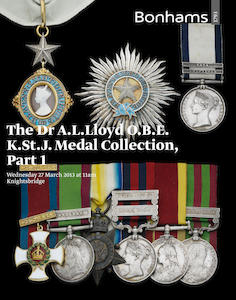
auction catalogue image
In contrast to DNW, Bonham's sale consisted of a single collection (in fact, just Part I of the collection) - the Dr A L Lloyd Collection of medals to medical personnel.

It was a lovely selection of material and just went to show how collecting themes can over-lap, for there was something for everyone.  There were medals from the Napoleonic Wars to modern conflicts; campaign awards; orders; gallantry awards; and long service medals.  Although there were medals to doctors and nurses who served in the Army and Air Forces, I'll pick out a couple of early pieces to naval surgeons.

A C.B. and K.H. group of four to Inspector of Hospitals and Fleets G.Macgrath, Royal Navy, and one of Lord Nelson's famous Surgeons,
Sir George Magrath's medal group - £14,400
The item that caught press attention both before and after the sale was the lot to Horatio Nelson's personal surgeon, Sir George Magrath, which sold for £14,400.  The long catalogue entry quoted from several of Nelson's letters, in which he described Magrath as 'the most able medical man I have seen' and 'Mr Magrath, whom I admire for his great abilities every day that I live'.  He missed being with Nelson at Trafalgar as he was left in Gibraltar to assist with an outbreak of yellow fever.  In later years he was Inspector of Hospitals and Fleets for the Royal Navy.

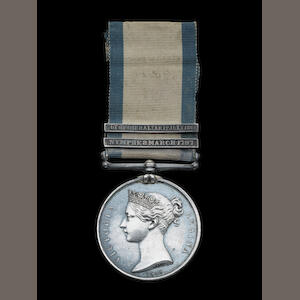
Naval General Service 1793-1840,
Naval General Service Medal to Surgeon B F Outram
 - an eye-watering £33,600.
Less eye-catching, but rather more desirable to at least two collectors was the single Naval General Service Medal to Surgeon B F Outram.  Although Outram (later Sir Benjamin Fonseca Outram KCB) had a distinguished career (he also was Inspector of Hospitals and Fleets), it is the numanistic aspects which are more important here than the 'man behind the medal'.  The medal has the clasps 'Nymphe, 8th March 1797' and 'Gut of Gibraltar 12th July 1801'.  The first clasp marks the engagement between HMS San Fiorenzo (Capt Sir Harry Neale), HMS Nymphe (Capt John Cooke) and the French ships Résistance (Cmdre Jean-Baptiste Montagniés Laroque) and Constance (Capt Desauney), who were returning from the farcical invasion of Pembrokeshire.  The second was awarded for an action off Cadiz when Sir James Saumarez defeated the French and Spanish fleets in July 1801. 

The significance of all this lies in the fact that the Naval General Service Medal wasn't awarded until 1847 and only to those surviving veterans who went through the application process.  As a result, some of the early, 'single ship' clasps were only claimed by a very few men.  Although 144 of the 'Gut of Gibratar' clasps were issued, there were only 5 of the 'Nymphe'.  This is a unique combination.  One knowledgeable collector of Naval General Service medals described this as a 'once in a lifetime' purchase.  Oddly enough, there was no indication of this scarcity factor in Bonham's catalogue description.  With an estimate of £5,000-7,000, the medal sold for an eye-watering £33,600 (inc premium).

Tuesday, 11 December 2012

More Polar Medals from the RC Witte Collection

Back at the end of August when I reviewed the last medal auction from DNW, I focused on what they termed 'Exceptional Naval and Polar Awards from the Collection of RC Witte' and talked about the medals of Frank Wild, who had commanded the party Shackleton left on Elephant Island.  In the sale this Thursday, there are 24 more items from this collection, and they are crackers, covering some of the most iconic naval engagements of the First World War and the interwar period.

But again my eyes are drawn to the polar medals.

Sir Ernest Shackleton
Here there are three more of the men who were member of Shackleton's ill-fated Trans-Antarctic Expedition of 1914-16.  Their ship, the Endurance, became trapped in the ice of the Weddell Sea and had to be abandoned in November 1915. Left with three lifeboats and meagre rations, Shackleton and his men undertook a remarkable journey, camping out on floes that eventually took them 1600 miles north. Then, at last, in early April 1916, the ice began to break up, allowing them to launch their lifeboats in a bid to reach Elephant Island, 60 miles distant. Shackleton mounted what was to become one of the great open-boat voyages of all time, namely his remarkable journey in the James Caird to South Georgia, 800 miles distant, from whence a successful rescue mission was mounted to collect the 22 men who had been left on Elephant Island.

Medals of A.H. Macklin, physician, polar explorer and soldier
The first of these men is the expedition's surgeon, Alexander Hepburne Macklin.  Remarkably, after their terrible experiences Shackleton's men all joined in the war effort on their return from the South Atlantic.  Macklin joined the Royal Army Medical Corps and earned a Military Cross for treating wounded under fire in Italy in 1918.  He then volunteered for service in North Russia, where he was awarded the OBE and the Russian Order of St. Stanislaus, 2nd Class, with swords, in addition to being mentioned in despatches.

After the war, Macklin joined up with Shackleton again for a further expedition South, sailing in the Quest.  He was attending Shackleton in the early morning of 5 January 1921 when the great explorer suffered a fatal heart attack and died.  

Macklin settled in Dundee and practiced medicine, but his adventures weren't over - during the Second World War he saw service as a Lt-Col in the RAMC, seeing action in East Africa.

Mount Macklin in the Salvesen Range on South Georgia is named after him.


Medals of C.J Green, cook to the Endurance expedition
The second group is to Charles John Green who was serving as a baker aboard the P & O’s Andes when Shackleton’s Endurance called in at Buenos Aires in October 1914.  Hearing that the expedition was looking for a cook, he signed up.  Green was obviously a valued member of the crew - he agreed to go on Shackleton's next expedition while they were still abandoned on the ice in 1916!  Accordingly he, too, was a member of the Quest expedition.

Tom Crean
Lastly, there is the polar medal to one of the great Antarctic heroes, Chief Petty Officer Tom Crean.

Crean was a member of Scott's of both of Scott’s Antarctic expeditions and Shackleton’s 1914-16 expedition.  This medal is for Scott's first expedition, where he made a great impression.  On Scott's second voyage, Crean was in the running to be a member of the final polar party but (luckily for him) was not selected.  Instead, it was Crean who found the abandoned tent that contained the bodies of Scot and his companions.  In the meantime, Crean had saved the life of Edward R. G. R. Evans, the expedition's second-in-command.  He was awarded the Albert Medal for his gallantry.

On Shackleton's Trans-Antarctic Expedition, Crean took command of one of ship’s boats in the epic boat-hauling journey that finally brought the team to open water - and their eventual arrival on Elephant Island.  Shackleton selected Crean as one of the crew of the boat that he proposed to take to South Georgia, one of the greatest - if not the greatest - survival stories in the annals of Polar exploration.  Shackleton later wrote:
Crean's polar medal
One of the memories that comes to me from those days is of Crean singing at the tiller. He always sang while he was steering, and nobody ever discovered what the song was. It was devoid of tune and as monotonous as the chanting of a Buddhist monk at his prayers; yet somehow it was cheerful.
On arrival at South Georgia in May 1916, the three weakest crew members were left with the James Caird, while Shackleton, Worsely and Crean undertook a momentous 36 hour trek, via mountain tops and glaciers, to reach the safety of the whaling station on the other side of the island - a journey never undertaken before. And after collecting their fellow crew members from the James Caird, as well as the boat itself, Shackleton, Worsley and Crean succeeded, after frustrating delays, in rescuing all 22 castaways on Elephant Island.

These are just three of the lots from the 1714 on offer.  There's loads else to see - not least a lovely collection of lifesaving awards.

Edit - 14 Dec 2012

Macklin's group (estimate  £18,000-£22,000) hammered for £31,000
Green's group (estimate £4,000-£5,000) hammered for £8,000
Crean's medal (estimate £25,000-£30,000) hammered for £23,000

To these prices should be added about 25% to cover fees and taxes.

Wednesday, 21 November 2012

It never rains, but it pours...

The planets have trundled along in their tracks and come along to one of those conjunctions that cause medal collectors to pull their hair out - yes, the winter auctions are with us.

For some reason the big four auction houses have their quarterly sales around the same time, which always causes a glut of choice.  This time it seems worse than usual.  We have the following sales coming up.

22 November Spink
29 November Morton and Eden (Sotheby's)
12/13 December DNW
13 December Bonhams
Each play to their own strengths - Morton and Eden have a large section of World Medals and Orders, which are always eye-catching a attract the big spenders (particularly in the last twenty years, the Imperial Russian orders, which are favoured by oligarchs).  DNW go for both quality and quantity - in a massive sale of 1715 lots they have a Boer War Victoria Cross, two George Crosses, George Medals and more other gallantry medals than you can shake a stick at.  They are also dispersing a large collection of lifesaving medals, which look interesting.

As I say, we're spoilt for choice.  Fortunately, I can't afford to buy anything so it isn't a problem for me.

A Sea Gallantry Medal group of three awarded to Quartermaster Robert Matthews, S.S. Cymric, awarded three life saving medals for saving life on the St. Cuthbert, 1908

Thursday, 13 September 2012

DNW Sale: Day One

I'm having serious medal-withdrawal symptoms at the moment, and am feeling accordingly grumpy.

Today was day one of one of DNW's quarterly sales (the big one before the OMRS Conference) and I was prepared to settle down in front of the laptop for seven hours of LiveBid.  I can't afford to buy anything, so I might as well watch, eh?

Unfortunately, The Wife (Who I Love Dearly) decided that it was necessary to do an on-line shop.  This also takes seven hours, but involves a lot more swearing than heard at DNW.  I suppose I accept her point that we need to eat - but if we didn't buy food, I might be able to afford medals...

Instead I walked the dog and made myself useful in the garden.   I don't feel  any sense of achievement though.  Under the new austerity measures, I couldn't even go to the Red Roaster and get a caffine fix.

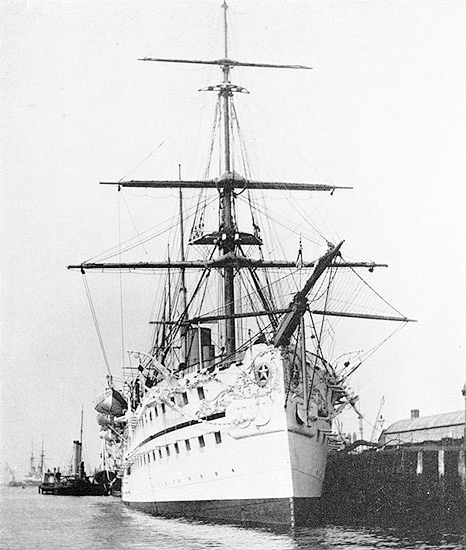
HMS Malabar
There were a couple of lots I was interested in (in an academic way, what with having No Visible Means of Support):
Lot No. 115
Lot 115
Egypt and Sudan 1882-89, dated reverse, no clasp (A. Robb, Cooper, HMS Malabar) edge bruising, contact marks, nearly very fine
£70-90
Went for £160 hammer, which is what I would have paid (as I've said before auctioneer's estimates 'tend' towards the low side- £70-90 is what you might have expected to pay ten years ago).  I hadn't done any research on him, but Cooper is a nice rate. He might have been any one of several Alexander Robbs in the navy at the time.  HMS Malabar was a troopship - quite a nice looking one.  I have a soft spot for mid to late nineteenth century shipping.


Lot 560 - Books
Trendell, A. J. R., The Colonial Year Book 1892; Mercer, Harding & Gent, The Dominions Office and Colonial Office List 1931; [H.M.S.O.], The Colonial Office List 1960; Hertslet, G. E. P. (Editor) The Foreign Office List (4) 1938; 1944; 1947; 1950; Walford, E., The County Families of The United Kingdom 1873; Kelly’s Handbook to the Titled, Landed and Official Classes (3) 1904; 1964; 1969; Debrett’s Peerage, Baronetage and Knightage (2) 1893; 1906, Who’s Who 1946; some volumes damaged, badly worn, poor and better condition (14)
£30-40
It seemed an interesting mix.  Went for £75 hammer, which is the retail price of a decent second-hand copy of one of the Debrett's
I haven't had the heart to have a proper look at how anything else sold today.  Nobody's flagged anything particularly remarkable over on the British Medals Forum.

Tomorrow it's groups and gallantry, including the RC Witte collection, I've posted about previously.  Expect some Big Money to be spent.

Friday, 31 August 2012

A Naval and Polar Medal Miscellany

Last week I blogged about the Bentley Priory Battle of Britain Trust Appeal charity auction at Spinks.  Another date in the medal collecting calender is looming - one of Dix Noonan Webb's quarterly sales.

This is a completely different beast from the Bentley Priory sale, which is only 56 lots and predominantly RAF-related.  By contrast, DNW covers all areas in a massive 1103 lots.  It's accordingly more difficult to pick out choice items.

My eye is always drawn to naval and polar items, and lots 993-1014 are 'Exceptional Naval and Polar Awards from the Collection of RC Witte'.  I don't know anything about RC Witte other than that he is Richard C Witte, the author of Fringes of the Fleet and the Distinguished Service Cross (1997) and Naval Double DSOs (1998).  These were apparently written from collecting experience!

Frank Wild's CBE and Polar Medal
 Part I of his collection was sold by DNW in December 2007.  That included the truly exceptional group to Frank Wild 'who, with the exception of Sir Ernest Shackleton, participated in more Antarctic expeditions than any other man'.  Sadly the CBE and Polar Medal (one of only two issued with four bars) had been 'split' from this group in the 1970s - they were subsequently sold in 2009


As well as some eye-watering naval gallantry, this batch of Witte's collection also includes a couple more important polar groups:
A rare and poignant Boer War and Polar Medal pair awarded to Able Seaman G T Vince, Royal Navy, who died in Scott’s first Antarctic expedition in March 1902, after slipping down a steep ice slope during a blizzard while employed in a sledging party under Frank Wild.
and 
The unique Murmansk 1919 operations DSO, Shackleton 1914-16 Antarctic Expedition OBE, Q-Ship operations DSC group of twelve awarded to Commander J R Stenhouse, Royal Naval Reserve: according to Shackleton ‘he accomplished successfully one of the most difficult journeys on record, in an ocean area notoriously stormy and treacherous’ - just one chapter in a truly remarkable career spanning ‘square-riggers’ in the early 1900s to his death in action in September 1941
The Stenhouse group