Showing posts with label Auctions. Show all posts

Thursday, 28 March 2013

I should have blogged about... (#2)

Another thing I didn't blog about during my little hiatus was the latest batch of medal auctions from the 'Big Four'.  On Monday and Tuesday of this week we had DNW and on Wednesday Bonhams.

DNW sales are always jam-packed full of goodies and, with over  1,200 lots, take two days to clear.  It's always difficult to decide what to draw attention to when blogging on one of them.  There were some very nice lifesaving medals, which are an interest of mine.  Some were from the collection of John Wilson, an expert on the awards on the Society for the Preservation of Life from Fire (he literally wrote the book on the subject).  One group of medals that jumped out at me wasn't from John's collection, but was to a bathing superintendent, Frank Shooter, who was credited with saving over 300 lives during a remarkable career.  For some reason these were unsold - perhaps the estimate of £3,000-3,500 was just a little too rich when there was so much else on offer.

Launcelot Fleming's medals


The Right Reverend Launcelot Fleming (1906–1990), KCVO, DD
Bishop Launcelot Fleming
Another group that appealed to me on several levels (except for the price!) was that to Launcelot Fleming.  After studying geology and glaciology at Cambridge, he was ordained into the Church of England.  Unusually, he was then invited to join expeditions to Iceland in 1932, Svalbard (Spitsbergen) in 1933, and then the British Graham Land Expedition to Antarctica, 1934-37.  During the Second World War he was a naval chaplain, among other postings, serving on the battleship HMS Queen Elizabeth.  In 1949, despite having little parish experience, he was appointed Bishop of Portsmouth and, in 1959, Bishop of Norwich.  After retiring from that diocese in 1971, he became Dean of Windsor (he officiated at the funeral of the Duke of Windsor).  He died in 1990.  I'm pleased to say that his medals have returned to Norfolk, where they will be held by a private collector.

auction catalogue image
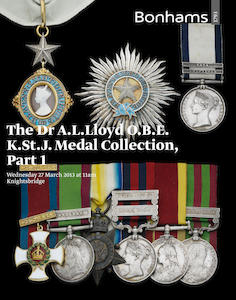
In contrast to DNW, Bonham's sale consisted of a single collection (in fact, just Part I of the collection) - the Dr A L Lloyd Collection of medals to medical personnel.

It was a lovely selection of material and just went to show how collecting themes can over-lap, for there was something for everyone.  There were medals from the Napoleonic Wars to modern conflicts; campaign awards; orders; gallantry awards; and long service medals.  Although there were medals to doctors and nurses who served in the Army and Air Forces, I'll pick out a couple of early pieces to naval surgeons.

A C.B. and K.H. group of four to Inspector of Hospitals and Fleets G.Macgrath, Royal Navy, and one of Lord Nelson's famous Surgeons,
Sir George Magrath's medal group - £14,400
The item that caught press attention both before and after the sale was the lot to Horatio Nelson's personal surgeon, Sir George Magrath, which sold for £14,400.  The long catalogue entry quoted from several of Nelson's letters, in which he described Magrath as 'the most able medical man I have seen' and 'Mr Magrath, whom I admire for his great abilities every day that I live'.  He missed being with Nelson at Trafalgar as he was left in Gibraltar to assist with an outbreak of yellow fever.  In later years he was Inspector of Hospitals and Fleets for the Royal Navy.

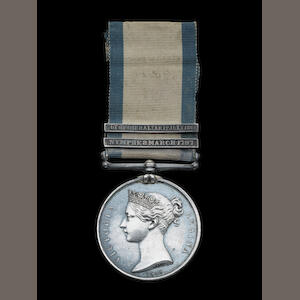
Naval General Service 1793-1840,
Naval General Service Medal to Surgeon B F Outram
 - an eye-watering £33,600.
Less eye-catching, but rather more desirable to at least two collectors was the single Naval General Service Medal to Surgeon B F Outram.  Although Outram (later Sir Benjamin Fonseca Outram KCB) had a distinguished career (he also was Inspector of Hospitals and Fleets), it is the numanistic aspects which are more important here than the 'man behind the medal'.  The medal has the clasps 'Nymphe, 8th March 1797' and 'Gut of Gibraltar 12th July 1801'.  The first clasp marks the engagement between HMS San Fiorenzo (Capt Sir Harry Neale), HMS Nymphe (Capt John Cooke) and the French ships Résistance (Cmdre Jean-Baptiste Montagniés Laroque) and Constance (Capt Desauney), who were returning from the farcical invasion of Pembrokeshire.  The second was awarded for an action off Cadiz when Sir James Saumarez defeated the French and Spanish fleets in July 1801. 

The significance of all this lies in the fact that the Naval General Service Medal wasn't awarded until 1847 and only to those surviving veterans who went through the application process.  As a result, some of the early, 'single ship' clasps were only claimed by a very few men.  Although 144 of the 'Gut of Gibratar' clasps were issued, there were only 5 of the 'Nymphe'.  This is a unique combination.  One knowledgeable collector of Naval General Service medals described this as a 'once in a lifetime' purchase.  Oddly enough, there was no indication of this scarcity factor in Bonham's catalogue description.  With an estimate of £5,000-7,000, the medal sold for an eye-watering £33,600 (inc premium).

Tuesday, 11 December 2012

More Polar Medals from the RC Witte Collection

Back at the end of August when I reviewed the last medal auction from DNW, I focused on what they termed 'Exceptional Naval and Polar Awards from the Collection of RC Witte' and talked about the medals of Frank Wild, who had commanded the party Shackleton left on Elephant Island.  In the sale this Thursday, there are 24 more items from this collection, and they are crackers, covering some of the most iconic naval engagements of the First World War and the interwar period.

But again my eyes are drawn to the polar medals.

Sir Ernest Shackleton
Here there are three more of the men who were member of Shackleton's ill-fated Trans-Antarctic Expedition of 1914-16.  Their ship, the Endurance, became trapped in the ice of the Weddell Sea and had to be abandoned in November 1915. Left with three lifeboats and meagre rations, Shackleton and his men undertook a remarkable journey, camping out on floes that eventually took them 1600 miles north. Then, at last, in early April 1916, the ice began to break up, allowing them to launch their lifeboats in a bid to reach Elephant Island, 60 miles distant. Shackleton mounted what was to become one of the great open-boat voyages of all time, namely his remarkable journey in the James Caird to South Georgia, 800 miles distant, from whence a successful rescue mission was mounted to collect the 22 men who had been left on Elephant Island.

Medals of A.H. Macklin, physician, polar explorer and soldier
The first of these men is the expedition's surgeon, Alexander Hepburne Macklin.  Remarkably, after their terrible experiences Shackleton's men all joined in the war effort on their return from the South Atlantic.  Macklin joined the Royal Army Medical Corps and earned a Military Cross for treating wounded under fire in Italy in 1918.  He then volunteered for service in North Russia, where he was awarded the OBE and the Russian Order of St. Stanislaus, 2nd Class, with swords, in addition to being mentioned in despatches.

After the war, Macklin joined up with Shackleton again for a further expedition South, sailing in the Quest.  He was attending Shackleton in the early morning of 5 January 1921 when the great explorer suffered a fatal heart attack and died.  

Macklin settled in Dundee and practiced medicine, but his adventures weren't over - during the Second World War he saw service as a Lt-Col in the RAMC, seeing action in East Africa.

Mount Macklin in the Salvesen Range on South Georgia is named after him.


Medals of C.J Green, cook to the Endurance expedition
The second group is to Charles John Green who was serving as a baker aboard the P & O’s Andes when Shackleton’s Endurance called in at Buenos Aires in October 1914.  Hearing that the expedition was looking for a cook, he signed up.  Green was obviously a valued member of the crew - he agreed to go on Shackleton's next expedition while they were still abandoned on the ice in 1916!  Accordingly he, too, was a member of the Quest expedition.

Tom Crean
Lastly, there is the polar medal to one of the great Antarctic heroes, Chief Petty Officer Tom Crean.

Crean was a member of Scott's of both of Scott’s Antarctic expeditions and Shackleton’s 1914-16 expedition.  This medal is for Scott's first expedition, where he made a great impression.  On Scott's second voyage, Crean was in the running to be a member of the final polar party but (luckily for him) was not selected.  Instead, it was Crean who found the abandoned tent that contained the bodies of Scot and his companions.  In the meantime, Crean had saved the life of Edward R. G. R. Evans, the expedition's second-in-command.  He was awarded the Albert Medal for his gallantry.

On Shackleton's Trans-Antarctic Expedition, Crean took command of one of ship’s boats in the epic boat-hauling journey that finally brought the team to open water - and their eventual arrival on Elephant Island.  Shackleton selected Crean as one of the crew of the boat that he proposed to take to South Georgia, one of the greatest - if not the greatest - survival stories in the annals of Polar exploration.  Shackleton later wrote:
Crean's polar medal
One of the memories that comes to me from those days is of Crean singing at the tiller. He always sang while he was steering, and nobody ever discovered what the song was. It was devoid of tune and as monotonous as the chanting of a Buddhist monk at his prayers; yet somehow it was cheerful.
On arrival at South Georgia in May 1916, the three weakest crew members were left with the James Caird, while Shackleton, Worsely and Crean undertook a momentous 36 hour trek, via mountain tops and glaciers, to reach the safety of the whaling station on the other side of the island - a journey never undertaken before. And after collecting their fellow crew members from the James Caird, as well as the boat itself, Shackleton, Worsley and Crean succeeded, after frustrating delays, in rescuing all 22 castaways on Elephant Island.

These are just three of the lots from the 1714 on offer.  There's loads else to see - not least a lovely collection of lifesaving awards.

Edit - 14 Dec 2012

Macklin's group (estimate  £18,000-£22,000) hammered for £31,000
Green's group (estimate £4,000-£5,000) hammered for £8,000
Crean's medal (estimate £25,000-£30,000) hammered for £23,000

To these prices should be added about 25% to cover fees and taxes.

Thursday, 29 November 2012

Sir William Parker

Admiral of the Fleet Sir William Parker, GCB, Bart

Sir William Parker was born on 1 December 1781 in Almington, Staffs, the son of Thomas Parker.  He was a nephew of Sir John Jervis, Earl St Vincent

He entered the Royal Navy on 5 March 1793 as Captain's Servant to Capt John Thomas Duckworth, HMS Orion, on which he served in the West Indies and was present at the Battle of the Glorious First of June. He followed Duckworth into HMS Leviathan and was appointed Acting Lieutenant in June 1798, shortly afterwards joining HMS Queen, the flagship of Admiral Sir Hyde Parker.  While on the West Indies Station, he was given temporary command of the sloops Volage, Amaranthe and Pelican.  While in command of HMS Stone (in which he served in the West Indies, the North Sea and the Channel), he captured the French Packet La Legere with a valuable cargo, and, in company with HMS La Constance, the Spanish privateer El Cantara. He was made Post Captain on 9 October 1801.

HMS Amazon in action, by Nicholas Pocok


He took command of HMS Amazon in November 1802, staying with her until February 1812.  He served in the Mediterranean Fleet under the command of Admiral Lord Nelson, who he soon impressed as a fine frigate captain.  At one point Nelson suspected that Sir John Orde, commanding ships around the Spanish coast, was intercepting his despatches and commandeering Nelson's frigates to use himself.  Nelson therefore ordered Parker not to stop for any of Orde's ships - Parker attempted this but was intercepted by HMS Eurydice.  He was however able to convince the Eurydice's commander to turn a blind eye and having delivered his despatches to Lisbon, acted on Nelson's hint that he was not expected back until February by carrying out a cruise that netted him several prizes worth a total of £20,000.  Orde complained about the 'poaching' taking place on his station, but the prize money went to Parker and Nelson.  Nelson remarked of him 'I admire his spirit and resolution to attack… under all the disadvantages of situation; such conduct will some happy day meet its reward.’

Parker and Amazon took part in the pursuit of Villeneuve, but missed out on Trafalgar.  After Nelson's death, Parker continued to distinguish himself.  Amazon was back in the Atlantic in 1806, this time as part of Sir John Borlase Warren’s pursuit of Jean-Baptiste Philibert Willaumez. When Warren's fleet unexpectedly encountered a separate French fleet under Charles-Alexandre Léon Durand Linois, Amazon became involved in the resulting Action of 13 March 1806.  During the battle she hunted down and captured the 40-gun frigate Belle Poule in a running engagement. The Amazon lost four killed and five wounded during the engagement, while the Belle Poule lost six killed and 24 wounded.

After leaving the Amazon, Parker was ashore until 1827, when he took command of HMS Warspite, serving as senior naval officer in the Aegean.  He was given command of the Royal Yacht, Prince Regent in 1829 and promoted rear-admiral in 1830.  In April 1831 was appointed second in command of the Channel Squadron, under Sir Edward Codrington. In September 1831 he was detached on an independent command at Lisbon, aboard Asia where he went to protect British interests during the Portuguese Civil War. When he returned to England he was appointed one of the Lords of the Admiralty.

First Opium War


He left the Admiralty in 1841, and was appointed commander-in-chief of the East Indies and China Station. Parker sailed for Hong Kong and assumed command of the squadron on 10 August 1841, raising his flag in the Cornwallis.  In this role, Parker commanded naval forces during the First Opium War, supervising operations from the capture of Amoy to the pacification of Nanking.  He was advanced to GCB and created a Baronet in recognition of his services.

In 1845 was Commander-in-Chief, Mediterranean Fleet. In May 1846, because of his knowledge of Portugal and its politics, he was given the additional command of the Channel Squadron while still remaining in charge of the Mediterranean. He was briefly (for a week) First Naval Lord in July 1846 but gave up the role due to ill health. He served as Commander-in-Chief, Plymouth from 1854 to 1857.

In 1863 he became an Admiral of the Fleet. He died on 13 November 1866 from complications from bronchitis, renowned as the last of Nelson's captains. He was buried in his parish churchyard near his home at Shenstone Lodge, and a monument to his memory was erected in Lichfield Cathedral.


Parker's medals and other items relating to him were sold by Morton and Eden on 29 November 2012.  They were

 In addition, Parker was a knight of the Order of St Ferdinand and of Merit (1815).

Thursday, 13 September 2012

DNW Sale: Day One

I'm having serious medal-withdrawal symptoms at the moment, and am feeling accordingly grumpy.

Today was day one of one of DNW's quarterly sales (the big one before the OMRS Conference) and I was prepared to settle down in front of the laptop for seven hours of LiveBid.  I can't afford to buy anything, so I might as well watch, eh?

Unfortunately, The Wife (Who I Love Dearly) decided that it was necessary to do an on-line shop.  This also takes seven hours, but involves a lot more swearing than heard at DNW.  I suppose I accept her point that we need to eat - but if we didn't buy food, I might be able to afford medals...

Instead I walked the dog and made myself useful in the garden.   I don't feel  any sense of achievement though.  Under the new austerity measures, I couldn't even go to the Red Roaster and get a caffine fix.

HMS Malabar
There were a couple of lots I was interested in (in an academic way, what with having No Visible Means of Support):
Lot No. 115
Lot 115
Egypt and Sudan 1882-89, dated reverse, no clasp (A. Robb, Cooper, HMS Malabar) edge bruising, contact marks, nearly very fine
£70-90
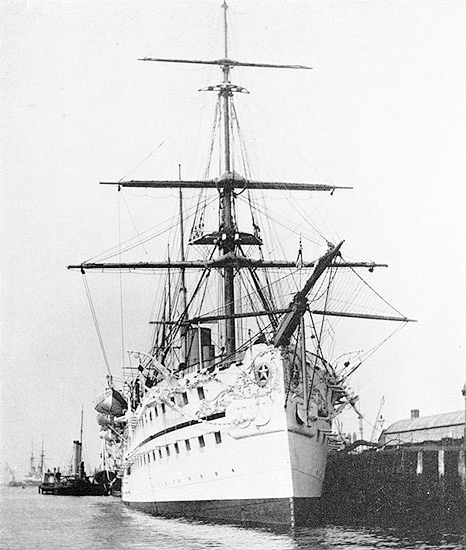
Went for £160 hammer, which is what I would have paid (as I've said before auctioneer's estimates 'tend' towards the low side- £70-90 is what you might have expected to pay ten years ago).  I hadn't done any research on him, but Cooper is a nice rate. He might have been any one of several Alexander Robbs in the navy at the time.  HMS Malabar was a troopship - quite a nice looking one.  I have a soft spot for mid to late nineteenth century shipping.


Lot 560 - Books
Trendell, A. J. R., The Colonial Year Book 1892; Mercer, Harding & Gent, The Dominions Office and Colonial Office List 1931; [H.M.S.O.], The Colonial Office List 1960; Hertslet, G. E. P. (Editor) The Foreign Office List (4) 1938; 1944; 1947; 1950; Walford, E., The County Families of The United Kingdom 1873; Kelly’s Handbook to the Titled, Landed and Official Classes (3) 1904; 1964; 1969; Debrett’s Peerage, Baronetage and Knightage (2) 1893; 1906, Who’s Who 1946; some volumes damaged, badly worn, poor and better condition (14)
£30-40
It seemed an interesting mix.  Went for £75 hammer, which is the retail price of a decent second-hand copy of one of the Debrett's
I haven't had the heart to have a proper look at how anything else sold today.  Nobody's flagged anything particularly remarkable over on the British Medals Forum.

Tomorrow it's groups and gallantry, including the RC Witte collection, I've posted about previously.  Expect some Big Money to be spent.

Saturday, 8 September 2012

Air Vice-Marshal F.D. 'Hawk Eyes' Hughes

Back when I blogged about Spink's  Bentley Priory Battle of Britain Trust Appeal Charity Auction.  I discussed 'Cat's Eyes' Cunningham, and used the following illustration.


Not 'Cat's Eyes' Cuningham's medal group

Well, of course, it's not Cunningham's group.  In the words of Spink (their punctuation, I assure you!) it is
The Important and Outstanding C.B., C.B.E., Second War D.S.O., D.F.C. and Two Bars, Post-War A.F.C. Group of Ten to Air Vice-Marshal F. D. 'Hawk Eyes' Hughes, Royal Air Force, Who Claimed His First Victories in Defiants During the Battle of Britain, and Added to His Score in Beaufighters in the Mediterranean and as a Squadron C.O. in Mosquitos Over North-West Europe; He Finished With A Personal Score of 18 Victories.
As a Native of the Emerald Isle He Was Second Only to 'Paddy' Finucane in Confirmed Victories, and was Right On The Tail of John 'Cat's Eyes' Cunningham As The Highest-Scoring Night Fighter Ace of the Second World War.
Frederick Desmond Hughes was born on 6 June 1919 in Belfast.  He was studying at Pembroke College, Cambridge, and a member of the University Air Squadron when he was called up in September 1939.  By the end of the war he was a Wing Commander, in command of 604 (County of Middlesex) Sqn, and was offered a permanent commission.  He retired in 1974 as an Air Vice-Marshal and died on 11 January 1992.


Citation for the award of the Distinguished Flying Cross
Flying Officer Frederick Desmond HUGHES (74706), Royal Air Force Volunteer Reserve, No.264 Squadron.
Flying Officer Hughes and Sergeant Gash as pilot and air gunner respectively have participated in numerous engagements against the enemy, both by day and night. During these flights four enemy aircraft have been destroyed, of which two were shot down at night.
 
London Gazette – 18 April 1941

Citation for the award of the Bar to the Distinguished Flying Cross
Acting Squadron Leader Frederick Desmond HUGHES, DFC (74706), Royal Air Force Volunteer Reserve, No. 600 Squadron.
As pilot and observer respectively, Squadron Leader Hughes and Flying Officer Dixon have flown together on many night sorties in operations in North Africa. During these flights they have destroyed 3 enemy aircraft. Squadron Leader Hughes and Flying Officer Dixon have displayed great skill and keenness, setting a praiseworthy example.
London Gazette – 13 April 1943
 
Citation for the award of the Second Bar to the Distinguished Flying Cross
“Acting Squadron Leader Frederick Desmond HUGHES, DFC (74706), Royal Air Force Volunteer Reserve, No.600 Squadron.
Squadron Leader Hughes is a brilliant night fighter whose determined efforts have met with further successes. Since being awarded a bar to 'the Distinguished Flying Cross he has destroyed 7 enemy aircraft. His total victories number at least 16, of which 13 have been destroyed at night. Squadron Leader Hughes is a highly efficient flight commander and his meritorious, work has been reflected in the efforts of his flight which has earned notable successes.
London Gazette - 28 September 1943

Hughes was awarded the DSO in 1945 and the AFC in 1954 he was appointed CBE in 1962 and CB in 1972.

Thursday, 6 September 2012

'Cats' Eyes' Cunningham Update

A little while ago, I blogged about Spink's  Bentley Priory Battle of Britain Trust Appeal Charity Auction.

Group Capt Cunningham's medal group

Among other things I said that the estimate of £140,000 for John ‘Cat’s Eyes’ Cunningham group 'is likely to be an under-estimate'.  Well, the sale was today and the lot fetched £320,000 (after extras, that'll be a total of £396,800).  That's an eye-watering sum of course, but it just confirms that the auctioneers' estimate was woeful.  They must have know (as we did) that the real result would be much more.  Why do they do this?  Some claim that it's a 'teaser', pulling punters in - but why tell someone they can buy something for much less that you know you want them to pay?  The real reason, I suspect, are the headlines in tomorrow's papers - 'medals sell for twice estimate'.

Anyway, as I said in the original blog, both the hammer price and the commission fees from this lot are going to charity.  So, that's a result then.

Friday, 24 August 2012

The Bentley Priory Battle of Britain Trust Appeal Charity Auction

The Spink publicity machine has kicked in for its The Bentley Priory Battle of Britain Trust Appeal Charity Auction on 6 September 2012.

The national press is focusing in on the sale of John ‘Cat’s Eyes’ Cunningham group, which include the CB, CBE, DSO, DFC and AFC.  The estimate is £60,000-80,000, but like most medal auctioneer's estimates this is likely to be an understatement - I've never understood the point of such 'teasers'.

Not 'Cat's Eyes' Cuningham's medal group - see edit


Meanwhile Spink have been tailoring their announcements to the local and regional press.  For example, the Express and Star in the West Midlands have featured the George Medal awarded to RAF Sergeant Kenneth Lythgoe,  a bomb disposal expert from Wolverhampton.

Lythgoe's group

Unusually, the sale will benefit charity.  Spink are donating their fees to the Bentley Priory Battle of Britain Trust appeal, which helps to preserve the site where Fighter Command had its HQ. The proceeds of the Cunningham lot will go towards flying scholarships for young people.

Edit - 7 Sep 2012

Oops..

I've used the wrong illustration for Cunningham's medal group. 

In addition, the estimate was £140,000.

Cunningham's real group