Monday, 17 December 2012

Admiral Sir Christopher Cradock

Sir Christopher Cradock, KCVO, CB, SGM

Christopher George Francis Maurice Cradock was born on 2 July 1862 at Hartford, Yorkshire, the fourth son of Christopher Cradock and his wife Georgina.

Cdr Cradock and dogs
He entered the Royal Navy in 1875 and saw his first action as a midshipman three years later during the occupation of Cyprus.  In 1884 he landed as part of the naval brigade, and served as part of the Eastern Sudan field force, being selected by the governor-general of the Red Sea to act as his aide-de-camp.  He was awarded the Order of the Medjidie.  After service on the Royal Yacht, he was promoted to Commander and served in the Third China War, commanding the combined British, German and Japanese naval brigade that stormed the Taku Forts in July 1900 (awarded the Prussian Order of the Crown) and the allied forces in the Relief of Tientsin.  He was noted for early promotion.


Cradock wrote two minor books; Sporting Notes in the Far East (1889) and Wrinkles in Seamanship (1894), but it was his Whispers from the Fleet (1907) that outlines his naval philosophy.  Addressed to officers entering upon their careers, he throws scorn on the civilians driving the naval arms race, who were 'for ever writing to the newspapers to prove... that unless we do something we shall in ten years time be seven-eighths of a battleship behind the combined navies of the world'.  As the DNB put it, 'to him the navy was not a collection of ships, but a community of men with high purpose'.


Wreck of the SS Delhi
Cradock was promoted Rear-Admiral in 1910.  In December the passenger ship SS Delhi grounded off Cape Spartel in Morocco.   Cradock in HMS London went to the assistance of the passengers, which included the King's sister, the Princess Royal, her husband the Duke of Fife and their children.  In bad weather, it took five days to ferry the 100 passengers to safety, and several seamen lost their lives.  Craddock was awarded the Sea Gallantry Medal.

In 1913 he took command of the North American and West Indies Station.  At the outbreak of war in August 1914, he had responsibility for an area from Canada to Brazil and the immediate duty of finding and destroying the German commerce-raiding cruisers, which were operating independently in the North and South Atlantics.  After satisfying himself that the North Atlantic trade routes were safe, Cradock joined the South Atlantic Squadron and raised his flag in HMS Good Hope, with the aim of sinking the cruiser Dresden.
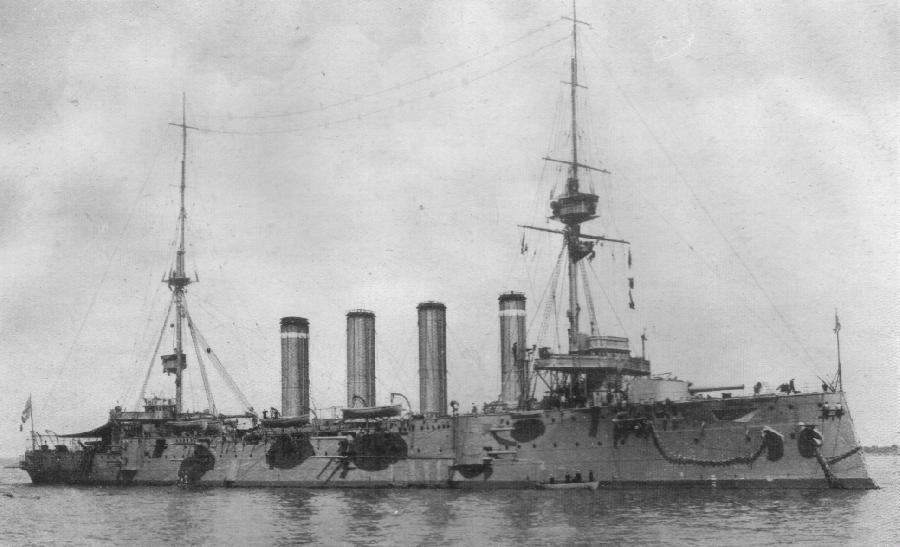
http://www.gwpda.org/naval/images/cfgoodhope.jpg
HMS Good Hope

While cruising off the east coast of South America, Cradock received information from the Admiralty that Admiral von Spee's German East Asia Squadron was moving eastwards across the Pacific, with the Falkland Islands coaling station as its presumed destination, and that Cradock should 'be prepared to meet them in company'.

Cradock's force consisted of obsolete and under-armed vessels, crewed by naval reservists called up a few months earlier.  These were the armoured cruisers HMS Good Hope and HMS Monmouth, the modern light cruiser HMS Glasgow, three other light cruisers, a converted liner—HMS Otranto—and two other armed merchantmen. The armoured cruiser HMS Defence, had been due to join the squadron, but this ship was diverted, and the pre-dreadnought battleship HMS Canopus took its place. Canopus had been due to be scrapped, but was reprieved on the outbreak of war: although designed to make 18.5 knots, she could barely manage 12 - half the speed of the rest of the squadron.  The Admiralty refused Craddock's request for further reinforcements.

After formally protesting his orders, Craddock split his forces in two; half to patrol the east coast of South America and the other the west coast.  Good Hope, Glasgow, Monmouth, Otranto and Canopus made up the west coast squadron and rounded the Horn, with Canopus detached and following the other ships as best she might.

Meanwhile, on 30 October a new board of Admiralty had been appointed with Lord Fisher as First Sea Lord.  They at once telegraphed to him that he was to keep his squadron concentrated and for reinforcement from Defence - and that he was not expected to fight without the Canopus. The new orders never reached him.

On October 29 Glasgow was sent to the port of Coronel in Chile, while there picked up radio transmissions between Leipzig and one of her colliers (the signals were warning von Spee of Glasgow's presence). The squadron was reformed and spread out to sweep north.  On 1 November 1914 Good Hope, Monmouth, Glasgow and Otranto encountered von Spee's force: Scharnhorst, Gneisenau, Leipzig and Dresden, with Nürnberg thirty miles to the north.  These modern vessels were much superior to Cradock's force.  Canopus was still 300 miles away to the south, escorting the squadron's colliers.

http://static1.akpool.de/images/cards/59/597325.jpg
Admiral Maximilian von Spee
Craddock drew the German force south.  With evening drawing on he had the option of withdrawing, falling back on Canopus' position;  had he done so, he would probably have escaped in the failing light, though he would have had to leave the slower Otranto to her fate.  However, his orders were to intercept and engage the enemy, and it was uncertain whether he would be able to find von Spee again.  Craddock was also aware that Rear-Admiral Troubridge, had been court-martialled that August for failing to engage the enemy despite the odds being against him.  Cradock turned towards the German line.

At about 1930 at 12,000 yards the German armoured cruisers opened fire, keeping their distance so as to stay out of the range of the British guns.  The setting sun silhouetted the British squadron whilst the German ships were hard to see in the failing light.  The third salvo from Scharnhorst hit Good Hope, knocking out her forward 9.2 inch gun. Monmouth was also hit by the third salvo from Gneisenau, setting her forward turret on fire. The visibility deteriorated so that the Germans had to target the fires on the British ships whilst the British had to make do with aiming at the enemy gun flashes. Leipzig and Glasgow engaged each other whilst Dresden fired on Otranto which rapidly pulled out of the line and fled, enabling Dresden to also engage Glasgow.  At 1950 Good Hope suffered a magazine explosion, the crippled ship then drifting out of site and sinking soon afterwards. There were no survivors.
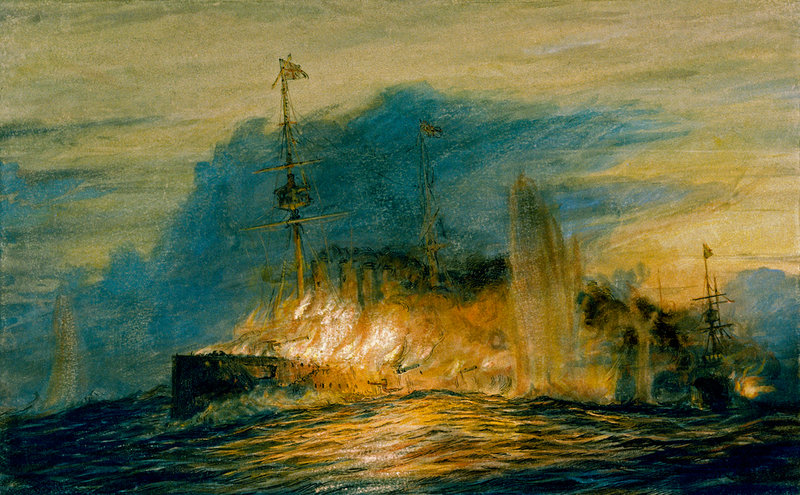
'Rear Admiral Cradock's flagship, HMS Good Hope on fire', by W.L. Wyllie

Monmouth was also on fire and listing to port. Glasgow had been hit five times and seeing that Monmouth was beyond help fled to avoid certain destruction and to warn Canopus to turn back. Nürnberg , ariving on the scene finished Monmouth off with gunfire at point blank. Again there were no survivors.

Within two hours the British had lost two battle cruisers and almost 1,600 men, including Admiral Cradock. The only damage to the Germans was two hits on Scharnhorst and four hits and three wounded on Gneisenau.

In response to the first major defeat suffered by the Royal Navy in over 100 years, and in answer to the continuing threat from von Spee's ships, a substantial new squadron was put together under the command of Vice-Admiral Doveton Sturdee (ironically as a demotion from a staff position following the changes at the Admiralty).  On 8 December 1914 von Spee, low on coal and having used half his ammunition at the Battle of Coronel, arrived at the Falkland Islands only to find Sturdee waiting for him.  In the ensuing battle, Scharnhorst, Gneisenau, Nürnberg and Leipzig were all sunk and von Spee and almost 2,200 German sailors killed.

Arthur Balfour (foreign secretary) unveils the memorial to Admiral Cradock at York 
(Click on link for movie)
Orders and Medals

Saturday, 15 December 2012

Richard III Update

Sir Ian McKellen - my favorite Richard

This blog has been following the story of the archeological search in Leicester for the remains of Richard III (use the label to see the other posts).

The Daily Telegraph is now reporting that it is almost certain that the body uncovered in September is that of the King, but that the news is being held back so it can be tied in with a TV documentary later this year.

This Week's Interesting Obits


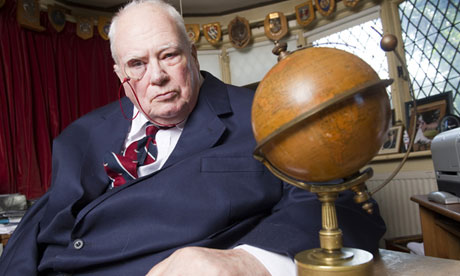
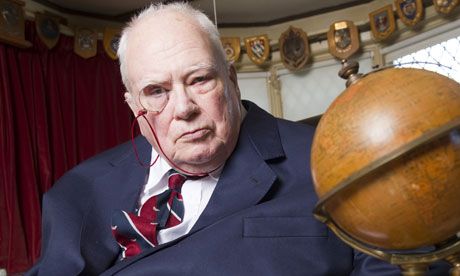
Sir Patrick Moore (d. 9 Dec 2012).  Astronomer and broadcaster
BBC 9 Dec 2012
Daily Telegraph, 10 Dec 2012 
Guardian, 10 Dec 2012
Independent, 10 Dec 2012
 

Friday, 14 December 2012

Order of the Indian Empire


Lord Northcote, Viceroy, wearing the collar of the order

The Order of the India Empire was the second of the orders of chivalry founded by Queen Victoria to mark meritorious service in India,  in order of precedence after the Order of the Star of India.  It was established by letters patent of 31 December 1877, following the adoption by Victoria of the title 'Empress of India' in 1876.

The Maharaja of Dhrangadhra-Halvad,
the last surviving member of the order
It originally consisted one class of membership - Companions - with the Sovereign and the Viceroy as Grand Master.  Members of the Council of the Governor-General were ex officio members.  In 1886 the order was expanded by the addition of Knights Commanders up to a maximum of 50 in number.  In 1887 it was reorganised into three classes: up to 25 Knights Grand Commanders (GCIEs), up to 50 Knights Commanders (KCIEs) and an unlimited number of Companions (CIEs).  As with the Order of the Star of India, the title 'Knight Grand Commander' was chosen rather than 'Knights Grand Cross so as not to offend the non-Christians member of the order.  The Governors of Madras, Bombay and Bengal were ex officio appointed GCIEs.

The order lapsed in 1947, following the independence of India and Pakistan.  The the last surviving member of the order, the Maharaja of Dhrangadhra-Halvad a KCIE, died in 2010.

Knight Grand Commander (GCIE)

The Maharao of Sirohi wearing the
mantle, collar and star of a GCIE
A GCIE's insignia consisted of a collar badge and a mantle of imperial purple or dark blue satin with a representation of the star on the left and tied with a white silk cord with gold tassles.

The mantle was only worn on special state occasions - in ordinary full dress uniform, a GCSI wore the star on the left breast and the badge on the left hip from a broad sash.

The collar was a silver-gilt chain composed of elephants, lotus flowers, peacocks in their pride and Indian roses with, in the centre the Imperial Crown.

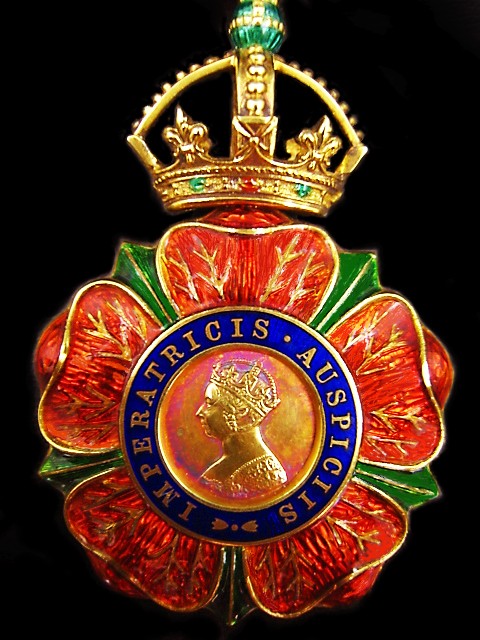
The badge was a gold five-petalled rose, enamelled crimson and with a green barb between each petal.

In the centre is an effigy of Queen Victoria in gold, surrounded by a purple ribbon originally inscribed VICTORIA IMPERATRIX, but from 1901 IMPERATRICIS AUSPICIIS ('under the auspices of the Empress).  The letters I N D I A were inscribed on the petals of the first type,
but not on the second.
GCIE neck badge

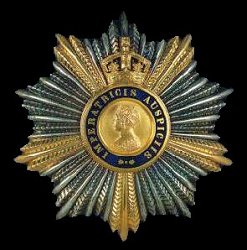
The star was composed of fine silver rays with smaller gold rays between them.; In the centre, within a purple circle bearing the motto of the order and surmounted by the Imperial Crown, is the effigy of Queen Victoria in gold.

Knight Grand Commander: Star
GCIE Star


Knights Commander (KCIE)
Sir Charles Augustus Tegart (1881–1946), KCIE, CSI, MVO, Calcutta Police, c.1940

Sir Charles Augustus Tegart, KCIE, CSI, MVO


KCIEs wore a badge round the neck and a star on the left breast.

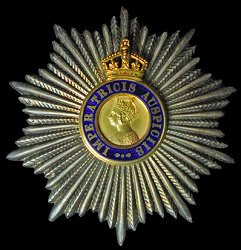
These were similar to those of GCIEs, but smaller and less lavishly decorated, the star being entirely of silver.

Knight Commander: Star
KCIE Star


Companions (CIE)

25CIE1a
CIE breast badge (1st type)
Companions originally wore a breast badge, but from 1917 these were worn at the neck.

As with the insignia of the other classes of the order, these came in two types - with and without the letters I N D I A.

Maj-Gen Sir Charles Metcalfe MacGregor, KCB, CSI, CIE


Books and Stuff

A weekly round-up of my book news.

What I've been reading...

Started Pat Barker, Life Class, and, in memory of Sir Patrick, Patrick Moore on Mars.

Finished The Lying Stones of Marrakech.


What I've bought...

Russell Chamberlin, Loot: The Heritage of Plunder - £1.00
Matthew Dennison, The Last Princess: The Devoted Life of Queen Victoria's Youngest Daughter - £4.99
Patrick Moore, 80 Not Out: The Autobiography - £2.81
Douglas Scott, The Preparatory Prologue: Douglas Haig, Diaries and Letters, 1861-1914 - £100

Michael Tillotson, The Fifth Pillar: The Life and Philosophy of the Lord Bramall, KG - £1.00
Anne Tyler, Digging to America - 50p
Anne Tyler, Ladder of Years - 50p


Wednesday, 12 December 2012

Royals in Medals #9: The Duke of York (and family)

Prince Andrew, Duke of York, KG, GCVO

The Duke of York was born on 19 February 1960 at Buckingham Palace, the second son and the third child of The Queen and The Duke of Edinburgh.  He was the first child to be born to a reigning monarch for 103 years; at the time of his birth he was second in line to the throne. He was christened Andrew Albert Christian Edward and was educated at Heatherdown Preparatory School, Ascot and Gordonstoun School in Morayshire.

On leaving Gordonstoun he entered Britannia Royal Naval College, Dartmouth, from which he passed out as an officer of the Royal Navy, in which he served for 22 years.  He qualified for the 'green beret' commando course and as a helicopter pilot.  He served during the Falklands War as part of 820 Naval Air Squadronon HMS Invincible.  He flew on various missions, including anti-submarine warfare and anti-surface warfare search. He also helped in casualty evacuation, transport and search and air rescue.  The Duke left the Royal Navy in 2001 in the rank of commander.

After service in the Royal Navy the Duke of York became a Special Representative for International Trade and Investment.  This role attracted some controversy: some questioned whether his international trips did anything to promote British trade, and he earned the nick-name 'Air Miles Andy'; for others he epitomised the worse of British overseas business dealings.

On Prince Andrew's marriage to Sarah Ferguson, he was created The Duke of York, Earl of Inverness and Baron Killyleagh, titles traditionally associated with the Monarch's second son.

Honorary Military Appointments


United Kingdom

    1350241S Prince Andrew
  • Colonel-in-Chief of the Royal Irish Regiment
  • Colonel-in-Chief of the Small Arms School Corps
  • Colonel-in-Chief of the Yorkshire Regiment
  • Royal Colonel of the Royal Highland Fusiliers, 2nd Battalion Royal Regiment of Scotland
  • Honorary Air Commodore, Royal Air Force Lossiemouth.
  • Commodore-in-Chief of the Fleet Air Arm
  • Admiral of the Sea Cadet Corps
The Duke holds the Honorary rank of Rear Admiral, Royal Navy.

Canada
  • Colonel-in-Chief of the Queen's York Rangers (1st American Regiment)
  • Colonel-in-Chief of the Royal Highland Fusiliers of Canada
  • Colonel-in-Chief of the Princess Louise Fusiliers
  • Colonel-in-Chief of the Canadian Airborne Regiment
New Zealand
  • Colonel-in-Chief of the Royal New Zealand Army Logistic Regiment

Orders, Decorations and Medals


Orders

Order of the Garter
Royal Knight (KG), 23 April 2006


Royal Victorian Order
Commander (CVO), 19 December 1979
Knight Commander (KCVO), 2 June 2003
Knight Grand Cross (GCVO), 21 February 2011


Campaign Medals

South Atlantic Medal w rosette BAR.svgSouth Atlantic Medal, with Rosette
The medal signifies participation in the Falklands War, 1982, and the rosette that the prince served within 35° and 60° South (ie, the active zone of operations).
 
Commemorative Medals
 
File:Queen Elizabeth II Silver Jubilee Medal ribbon.png  Queen Elizabeth II Silver Jubilee Medal 1977
Queen Elizabeth II Golden Jubilee Medal ribbon.png  Queen Elizabeth II Golden Jubilee Medal 2002
QEII Diamond Jubilee Medal ribbon.png  Queen Elizabeth II Diamond Jubilee Medal 2012
New Zealand 1990 Commemoration Medal ribbon.png  New Zealand Commemorative Medal 1990

Long Service Awards

CD-ribbon.png  Canadian Forces Decoration (CD), 2001

Foreign Awards

Norway.  Royal Norwegian Order of St. Olav - Grand Cross, 1988
United Arab Emirates.  Order of the Federation - 2010

Sarah, Duchess of York


Sarah Ferguson was born on 15 October 1959 the second daughter of Major Ronald Ferguson and his wife Susan. She married Prince Andrew in Westminster Abbey on 23 July 1986. At the time of their marriage Prince Andrew was created The Duke of York and Sarah became The Duchess of York. In March 1992 it was announced that The Duke and Duchess were to separate; they were divorced in May 1996.

The Duchess of York did not receive any orders or medals.

The couple had two children.
  • Beatrice Elizabeth Mary (born 8 August 1988) 
  • Eugenie Victoria Helena (born 23 March 1990)

As granddaughters of the monarch in the male line they were granted the style HRH and are Princesses of the United Kingdom.

Princesses Beatrice and Eugenie may be members of the Royal Family Order of Elizabeth II (this is not confirmed) and probably received the Golden and Diamond Jubilee Medals.

Royal Family Order of Elizabeth II


Queen Elizabeth II Golden Jubilee Medal ribbon.png  Queen Elizabeth II Golden Jubilee Medal 2002
QEII Diamond Jubilee Medal ribbon.png  Queen Elizabeth II Diamond Jubilee Medal 2012

Tuesday, 11 December 2012

More Polar Medals from the RC Witte Collection

Back at the end of August when I reviewed the last medal auction from DNW, I focused on what they termed 'Exceptional Naval and Polar Awards from the Collection of RC Witte' and talked about the medals of Frank Wild, who had commanded the party Shackleton left on Elephant Island.  In the sale this Thursday, there are 24 more items from this collection, and they are crackers, covering some of the most iconic naval engagements of the First World War and the interwar period.

But again my eyes are drawn to the polar medals.

Sir Ernest Shackleton
Here there are three more of the men who were member of Shackleton's ill-fated Trans-Antarctic Expedition of 1914-16.  Their ship, the Endurance, became trapped in the ice of the Weddell Sea and had to be abandoned in November 1915. Left with three lifeboats and meagre rations, Shackleton and his men undertook a remarkable journey, camping out on floes that eventually took them 1600 miles north. Then, at last, in early April 1916, the ice began to break up, allowing them to launch their lifeboats in a bid to reach Elephant Island, 60 miles distant. Shackleton mounted what was to become one of the great open-boat voyages of all time, namely his remarkable journey in the James Caird to South Georgia, 800 miles distant, from whence a successful rescue mission was mounted to collect the 22 men who had been left on Elephant Island.

Medals of A.H. Macklin, physician, polar explorer and soldier
The first of these men is the expedition's surgeon, Alexander Hepburne Macklin.  Remarkably, after their terrible experiences Shackleton's men all joined in the war effort on their return from the South Atlantic.  Macklin joined the Royal Army Medical Corps and earned a Military Cross for treating wounded under fire in Italy in 1918.  He then volunteered for service in North Russia, where he was awarded the OBE and the Russian Order of St. Stanislaus, 2nd Class, with swords, in addition to being mentioned in despatches.

After the war, Macklin joined up with Shackleton again for a further expedition South, sailing in the Quest.  He was attending Shackleton in the early morning of 5 January 1921 when the great explorer suffered a fatal heart attack and died.  

Macklin settled in Dundee and practiced medicine, but his adventures weren't over - during the Second World War he saw service as a Lt-Col in the RAMC, seeing action in East Africa.

Mount Macklin in the Salvesen Range on South Georgia is named after him.


Medals of C.J Green, cook to the Endurance expedition
The second group is to Charles John Green who was serving as a baker aboard the P & O’s Andes when Shackleton’s Endurance called in at Buenos Aires in October 1914.  Hearing that the expedition was looking for a cook, he signed up.  Green was obviously a valued member of the crew - he agreed to go on Shackleton's next expedition while they were still abandoned on the ice in 1916!  Accordingly he, too, was a member of the Quest expedition.

Tom Crean
Lastly, there is the polar medal to one of the great Antarctic heroes, Chief Petty Officer Tom Crean.

Crean was a member of Scott's of both of Scott’s Antarctic expeditions and Shackleton’s 1914-16 expedition.  This medal is for Scott's first expedition, where he made a great impression.  On Scott's second voyage, Crean was in the running to be a member of the final polar party but (luckily for him) was not selected.  Instead, it was Crean who found the abandoned tent that contained the bodies of Scot and his companions.  In the meantime, Crean had saved the life of Edward R. G. R. Evans, the expedition's second-in-command.  He was awarded the Albert Medal for his gallantry.

On Shackleton's Trans-Antarctic Expedition, Crean took command of one of ship’s boats in the epic boat-hauling journey that finally brought the team to open water - and their eventual arrival on Elephant Island.  Shackleton selected Crean as one of the crew of the boat that he proposed to take to South Georgia, one of the greatest - if not the greatest - survival stories in the annals of Polar exploration.  Shackleton later wrote:
Crean's polar medal
One of the memories that comes to me from those days is of Crean singing at the tiller. He always sang while he was steering, and nobody ever discovered what the song was. It was devoid of tune and as monotonous as the chanting of a Buddhist monk at his prayers; yet somehow it was cheerful.
On arrival at South Georgia in May 1916, the three weakest crew members were left with the James Caird, while Shackleton, Worsely and Crean undertook a momentous 36 hour trek, via mountain tops and glaciers, to reach the safety of the whaling station on the other side of the island - a journey never undertaken before. And after collecting their fellow crew members from the James Caird, as well as the boat itself, Shackleton, Worsley and Crean succeeded, after frustrating delays, in rescuing all 22 castaways on Elephant Island.

These are just three of the lots from the 1714 on offer.  There's loads else to see - not least a lovely collection of lifesaving awards.

Edit - 14 Dec 2012

Macklin's group (estimate  £18,000-£22,000) hammered for £31,000
Green's group (estimate £4,000-£5,000) hammered for £8,000
Crean's medal (estimate £25,000-£30,000) hammered for £23,000

To these prices should be added about 25% to cover fees and taxes.

Monday, 10 December 2012

Sir Francis Younghusband


Sir Francis Younghusband, KCSI, KCIE
Sir Francis Younghusband was an odd mix - soldier, colonial administrator, explorer and mystic.

Francis Edward Younghusband was born at Murree, in the North West Frontier (now Pakistan), on 31 May 1863, the second son of Major (later Major-General) John William Younghusband and his wife, Clara Jane.  His uncle was Robert Shaw, the first Englishman to cross the Himalyas to Yarkland and Kashgar - Francis was to undertake similar work in 'the Great Game', whereby Russia and British India strove for influence in Central Asia.

Afghanistan caught between Russia and Britain in 'the Great Game'
He was educated a Clifton College, near Bristol, and the Royal Military College, Sandhurst, being commissioned into the 1st (King's) Dragoon Guards in 1882.  In 1886 he joined Sir Henry Evan Murchison James on an expedition into Manchuria and China, visiting areas unseen by Europeans for almost two centuries.  Younghusband returned from Peking to India via the Gobi Desert, the first European to cross it. 

In 1889 he made further ventures into Central Asia north of British India, encountering Capt Grombehevski, who was doing similar work for the Russians.  Younghusband, now a captain, was attached to the Indian foreign department, and spent 1890-91 on a round trip to Kashgar - his encounters with Cossack patrols led to an international incident, and the British government forcing the Russians to back down in their plans to annex large swathes of territory next to Afghanistan.

Younghusband, c.1901
Younghusband published an account of his journeys in 1896 as The Heart of a Continent: A Narrative Of Travels In Manchuria, Across The Gobi Desert, Through The Himalayas The Pamirs And Hanza, which brought him to public attention.  He also accompanied to Chitral Relief Force as a correspondent for the Times (and probably acted in some other, more shadowy, capacity).  He was awarded the Founder's Medal of the Royal Geographical Society and appointed a CIE.

Younghusband was appointed a political officer in Husan and made a friendship with George Curzon (later the 1st Marquis Curzon, Viceroy of India).

He again acted a as corespondent for the Times in 1897-98, this time in South Africa, where he reported on the Jameson Raid, and the disputes which were to lead to the Second Boer War.

In 1902 Curzon appointed Younghusband head of a mission to Tibet, who was feared to be negotiating a settlement with the Russians.  Younghusband, with a military force commanded by J.R.L. Macdonald, exceeded his orders and lead an invasion of the country.  Despite Younghusband's assurances that at 'we are not at war with Tibet and that, unless we are ourselves attacked, we shall not attack the Tibetans' conflict soon arose.  The Tibetans were hopelessly outmatched and a series of what can only be described as massacres followed.
File:Younghusband-team-1904.jpg
Younghusband and staff in Tibet

Younghusband entered Lhasa in August 1904 and dictated terms to the Tibetan government, which paid an indemnity, recognized the Sikkim-Tibet border, and declared that Tibet would have no relations with any other foreign powers.

The invasion proved controversial in London, but Younghusband was eventually confirmed in his actions and advanced in KCIE.

From 1906 until his retirement in 1909, Younghusband was resident officer in  Kashmir.  He returned to England in 1910, and published India and Tibet.  He became prominent in the Royal Geographical Society, and served as it's president from 1919 to his death.  He was chairman of the Mount Everest Committee, which organised attempts to climb the mountain.  He was appointed KCSI in 1917.

Younghusband had become interested in spiritualism and Eastern Religions.  He published The Life in the Stars in 1927 and The Living Universe in 1933.  He helped in the organisation of the Conference of Religions of the Empire held in London in 1924 and founded the World Congress of Faiths in 1936.  His beliefs became increasingly bizarre, following a vision on the return from Tibet, Younghusband devised a new religion, arguing that there was a Supreme Being on an alien planet influencing events on Earth through telepathy and advocating Free Love.

Younghusband died at Lychett Minster, Dorset, the home of his mistress and follower, Lady Lees, on 31 July 1942.

Orders, Decorations and Medals


Order of the Star of India
Knight Commander (KCSI), 1917


Order of the Indian Empire
Companion (CIE), 1896
Knight Commander (KCIE), 1905


Kaisar-i-Hind Medal (in Gold), 1901


Tibet Medal BAR.svg Tibet Medal

Saturday, 8 December 2012

This Week's Interesting Obits


Hot on the heels of Ries Leming come another two holders of the George Medal


HERO Goronwy EvanGoronwy Evans (d. 7 Nov 2012).  Police officer awarded the George Medal for his actions during the Portsmouth Blitz, 1941
Portsmouth News, 23 Nov 2012


Arthur Rowlands in his police uniform Arthur Rowlands.  Police officer awarded the George Medal after being blinded when a burglar shot him, 1961.
BBC Wales, 2 Dec 2012


And not George Medal related, here's another, who just had a fascinating story to tell...

Major-General Tony Deane-Drummond

Major-General Tony Deane-Drummond (d. 4 Dec 2012).  Soldier who has several close shaves.
Daily Telegraph, 5 Dec 2012